Fr. Jeffrey Steel of De Cura Animarum has recently announced that he is swimming the Tiber. By last count that makes eight of my former students who have gone either to Rome or Orthodoxy. Jeff is a man of deep conviction and theological reflection, so I am confident that his conversion is the logical and necessary next step in his pilgrimage. Anglicanism's loss is Rome's gain, for Jeff is a gifted thinker. But alas, as Jeff knows firsthand, there is no greater struggle than to live in inconsistency. And for this next step, I rejoice with him and support him.
I wish him and his family all the best in this next chapter of their lives. They will be in my prayers while they relocate to London, seek employment, schools, etc.
Read about Jeff's conversion HERE.
Showing posts with label Roman Catholic. Show all posts
Showing posts with label Roman Catholic. Show all posts
Monday, June 08, 2009


Saturday, August 02, 2008
My Thoughts on the Fr. Kimel Kerfuffle
To quote myself:
At least one constructive thing has come out of the recent dialogue (charity compels me to call it such) between Fr. Al Kimel and myself. It has reminded me of my own words above. Indeed, it was Fr. Kimel himself who linked the article which contains the above quote to his most recent critque of my article "Personal Reflections on Why I Remain in TEC".
As I hinted in the "trailer" of a previous entry, Fr. Kimel has asked the wrong question, (or, perhaps better, an inadequate question) in the title of his article, "Is The Episcopal Church Truly a Catholic Church?" In so doing, he has unwittingly pigeon-holed himself into answering the question in terms of the relative orthodoxy of TEC's adherents, and thus comes across not as a Roman Catholic apologist debating the catholic claims of Anglicanism as much as he does a former Episcopalian displaying his disappointment and disenchantment with his former church's continuous flirtations with erroneous teaching (the pan-sexual agenda), or, in some cases, embracing of innovative positions (e.g., women's ordination). His arguments in this respect are not much different than those who have thrown their lot in with CANA or the AMiA, or the GAFCON movement for that matter.
Now, I'm not about to engage in a debate over or defend various recent actions of TEC. I should think that Fr. Kimel and I agree for the most part about these matters, and so these hardly need rehashing. My point, however, should not be missed: To argue against the catholicity of a particular church based on a point-in-time snapshot of the relative orthodoxy of its adherents, whether a majority or a significant tolerated minority, is to subject every church at every point in history (including one's own) to the same standard.
But does Fr. Kimel really want to go down that road? Does he really wish to uphold the relative orthodoxy of the adherents of Roman Catholicism throughout its long and less than exemplary history as the standard by which all others are judged catholic? Or is he claiming for Rome and its adherents an "abosulte orthodoxy and orthopraxy" by which all other catholic claimants are judged? (The recent comment from the Anglican Scotist about how Fr. Kimel wants "to make a clean, binary distinction in terms of esse sufficient to completely unchurch Episcopalians" is right on the money here.)
If that is the route Fr. Kimel would like to pursue, then perhaps we should begin our discussion with the sins of simony and nepotism, or the sale of grace through indulgences in the sixteenth century. Or perhaps we should bring the discussion into modern times, and talk about the "Ted Kennedys" and "Nancy Pelosis" of the world. Should we discuss the American Roman hierarchy's complicity in covering up the recent sex scandals and child molestations which some of her priests have perpetrated? I, for one, would rather not go down that road.
So, Fr. Kimel, let's not go there, because, unless one wishes to assume the foolish position of an absolute orthodoxy, there are no winners in such a contest. Instead, let's engage in a debate about the nature of catholicity itself. And I think a good place to begin would be with my quoted statement above. Show me how my "connection to" and "continuity with" the one, holy, catholic and apostolic church as mediated through the Church of England has been severed or interrupted by my remaining in The Episcopal Church.
I came to the conclusion some years ago that "Anglicanism" was not primarily about doctrine or formularies, but about connection to and continuity with the one, holy, catholic, and apostolic Church as mediated through the Church of England. So it seemed foolish to me to identify with Anglicanism on this level while aligning myself with a church or movement that almost entirely identified Anglicanism with doctrine (39 Articles) and formularies (1662 BCP). ("Why I Migrated to The Episcopal Church," Entry: July 30, 2007)
At least one constructive thing has come out of the recent dialogue (charity compels me to call it such) between Fr. Al Kimel and myself. It has reminded me of my own words above. Indeed, it was Fr. Kimel himself who linked the article which contains the above quote to his most recent critque of my article "Personal Reflections on Why I Remain in TEC".
As I hinted in the "trailer" of a previous entry, Fr. Kimel has asked the wrong question, (or, perhaps better, an inadequate question) in the title of his article, "Is The Episcopal Church Truly a Catholic Church?" In so doing, he has unwittingly pigeon-holed himself into answering the question in terms of the relative orthodoxy of TEC's adherents, and thus comes across not as a Roman Catholic apologist debating the catholic claims of Anglicanism as much as he does a former Episcopalian displaying his disappointment and disenchantment with his former church's continuous flirtations with erroneous teaching (the pan-sexual agenda), or, in some cases, embracing of innovative positions (e.g., women's ordination). His arguments in this respect are not much different than those who have thrown their lot in with CANA or the AMiA, or the GAFCON movement for that matter.
Now, I'm not about to engage in a debate over or defend various recent actions of TEC. I should think that Fr. Kimel and I agree for the most part about these matters, and so these hardly need rehashing. My point, however, should not be missed: To argue against the catholicity of a particular church based on a point-in-time snapshot of the relative orthodoxy of its adherents, whether a majority or a significant tolerated minority, is to subject every church at every point in history (including one's own) to the same standard.
But does Fr. Kimel really want to go down that road? Does he really wish to uphold the relative orthodoxy of the adherents of Roman Catholicism throughout its long and less than exemplary history as the standard by which all others are judged catholic? Or is he claiming for Rome and its adherents an "abosulte orthodoxy and orthopraxy" by which all other catholic claimants are judged? (The recent comment from the Anglican Scotist about how Fr. Kimel wants "to make a clean, binary distinction in terms of esse sufficient to completely unchurch Episcopalians" is right on the money here.)
If that is the route Fr. Kimel would like to pursue, then perhaps we should begin our discussion with the sins of simony and nepotism, or the sale of grace through indulgences in the sixteenth century. Or perhaps we should bring the discussion into modern times, and talk about the "Ted Kennedys" and "Nancy Pelosis" of the world. Should we discuss the American Roman hierarchy's complicity in covering up the recent sex scandals and child molestations which some of her priests have perpetrated? I, for one, would rather not go down that road.
So, Fr. Kimel, let's not go there, because, unless one wishes to assume the foolish position of an absolute orthodoxy, there are no winners in such a contest. Instead, let's engage in a debate about the nature of catholicity itself. And I think a good place to begin would be with my quoted statement above. Show me how my "connection to" and "continuity with" the one, holy, catholic and apostolic church as mediated through the Church of England has been severed or interrupted by my remaining in The Episcopal Church.
Thursday, July 31, 2008
The Anglican Scotist's Comment on the "Kimel Kerfuffle"
I grabbed this from the comments section of my entry that links to Fr. Al Kimel's "Is the Episcopal Church a Truly Catholic Church"(Click Here). As I've come to expect from him, the Anglican Scotist concisely gets right to the heart of the matter:
It seems [Kimel] will have to speak without contradicting Vatican II's ecclesiology, which might be difficult, given that he seems to want to make a clean, binary distinction in terms of esse sufficient to completely unchurch Episcopalians.
He may also have to ignore the significance of the distinction between (a) Christ being with the Church always, and (b) Christ chastising the church because he loves it. That is, it seems Christ may remain sufficiently present in the church he punishes, which implies deserving punishment--say for material heresy--does not alone entail abandonment.
Anyhow, let's hope he says something new soon; summer is draining away.
Interesting Take on the "Kimel Kontroversy"
Room With A View has weighed in on the latest from Al Kimel (see entry below). Doug Martin, a former Anglican and now a Roman Catholic convert, provides an interesting perspective.
Wednesday, July 30, 2008
"Is The Episcopal Church Truly a Catholic Church?" Fr. Al Kimel's Response to My Article
In the interest of fairness, I'm posting a link to De Cura Animarum so that my readers may read the ongoing dialogue between Fr. Al Kimel and me. He is invited to post directly to my blog if he so wishes.
By way of a trailer to my counter-response, I'll simply say that Fr. Kimel is asking the wrong question.
Postscript: It is interesting to note that Fr. Kimel did not actually choose to respond to my article "Al Kimel's Comments on My Recent Entries," but rather chose to continue his critique of my original article "Personal Reflections on Remaining in TEC," which obviously was not intended to be anything more than a brief rationale for staying in TEC and the Anglican Communion rather than throwing my lot in with GAFCON. Quite frankly, I think my response to Kimel provides much better material for a debate between a Roman and an Anglican. But perhaps there are issues that I raised in that article that he would rather not address.
Sunday, July 20, 2008
Al Kimel's Comments on My Recent Entries

Below is a portion of a post written by Al Kimel over at Per Caritatem. This entry was excised from the discussion of my recent brief essays "Personal Reflections for Remaining in TEC," "The Problem of Confessionalism," and "Restating a Third Mill Catholic Prophecy." Biretta tip to Cynthia Nielsen for bringing these posts to the attention of her readers, and for maintaining the best theological blog in the blogosphere bar none. See link for the discussion below.
+++++++
I don’t believe that most who are really struggling with the present direction of the Episcopal Church will find Fr Daniel Dunlap’s reflections very helpful. Basically he seems to be saying, Episcopalians are all over the place theologically, but the TEC and Anglican Communion still formally retain catholic creeds and catholic orders, so there’s no imperative to break communion. As Fr Dunlap writes, “the only thing that really matters at the end of the day is the Church’s credo, not our individual “credos,” and endeavoring to live into it.”
This, of course, has been precisely the line advanced by most orthodox Episcopalians during the past thirty years. It is a failed strategy, and it ignores the political, theological, and ecclesial and seminary realities now confronting the “orthodox” (however one draws the lines of “orthodoxy”).
+++++++
First, I'll make a concession. Yes, Episcopalians are all over the place theologically, but then so are Roman Catholics. The difference? The Romans have in place a magisterium and a very nuanced rationale for doctrinal development that, when taken together, have so far managed to cover over centuries of theological missteps and still leave room for an infallible definition or two from time to time. However, they also make good hiding places for the "existentialist-expressivists" for whom Fr. Kimel apparently has no liking, and whom Fr. Kimel apparently would rather pretend did not exist within the Roman camp.
Be that as it may, the magisterium-doctrinal development thesis is so ingrained in the Roman psyche that to deny its catholicity (which I do) seemingly places its detractors on a playing field slanted in favor of those who affirm it. Okay, fair enough. I accept the premise that an "Anglican magisterium" would make Anglican life so much easier. But would it make Anglicanism more "catholic"? Would it solve the issues that so divide the Anglican Communion today? Or, rather, would it solidify for all time certain theological innovations in the name of "Anglican doctrinal development"? I believe the latter to be more likely, and I believe that supposedly "infallible" Roman dogmas (e.g., the Immaculate Conception) make the point better than I ever could.
Such a scenario, of course, is nonsensical. An "Anglican magisterium" is about as oxymoronic a term as one can imagine. However, my point should be obvious: the Anglican way of being "catholic" (or living into catholicity) is different than the Roman way. So why is it that Roman apologists (many of them ex-Anglicans, I might add) only come out to play when they have homefield advantage? Obviously it's futile to argue for the catholicity of Anglicanism on Roman terms. So I won't. I will be content to argue for the catholicity of Anglicanism on Anglican terms.
At first, it may appear odd to my readers to hear me suggest that Anglicanism has its "own terms" or definition of catholicity. But it shouldn't. I have argued on a number of occasions that each of the three major apostolic communions (i.e., Roman, Byzantine, Anglican) operate on quite different understandings of what it means to be "one, holy, catholic, and apostolic." Romanism and Byzantinism both make claims of ecclesial ultimacy. But their respective claims are mutually exclusive, as the former insists on papal supremacy and the latter on the received faith of the ecumenical councils. Thus, despite whatever superficial similarities Rome and Byzantium may have, they are different ways of understanding what it means to be catholic. In contrast, Anglicanism has never made a claim of ecclesial ultimacy, and so defines itself not as the Catholic Church, but rather as a catholic church, and thus recognizes the other two communions as legitimate branches of "the one, holy, catholic, and apostolic Church." Unlike Fr. Kimel, I see this as Anglicanism's greatest strength, not its weakness. And if it survives the present struggles, then it will only be that much stronger.
You see, believe it or not, I still believe in "common prayer catholicity," which, contrary to Al Kimel's reductionism above, is more than just the formal retention of ancient creeds and apostolic orders. Neither is my position merely a "strategy," failed or otherwise, for the orthodox to stay put in TEC/Anglican Communion. I don't need a reason or a strategy to stay in TEC. Indeed, the burden of proof is STILL on those who insist that I should leave! Rather Anglicanism is a way of being catholic, or living into catholicity, that has proven itself very effective and extremely resilient over the last nearly 500 years of this independent Anglican experiment. I still believe that Anglicanism is a movement of God. I may be wrong. But why should I give up on it now?
Per Caritatem
Friday, July 11, 2008
So What Now? By Andrew Teather of "Anglican Wanderings"
It is almost impossible to collate the information below and produce some sort of commentary, not least because we are still waiting for statements from the Bishops of Beverley and Richborough. So far we do not have a consensus of opinion though. This points to the obvious answer that we are not going to have one, therefore we are, as an ecclesial body of Catholics in the Church of England, divided in this respect. Some of us, like one commentator on these pages, will shift position and say that it is possible to be a Catholic and accept the Ordination of women, a view which, in all fairness, has found some support even in the Roman Church, notably Bishop Conroy of Arundel and Brighton said that he had no objections whatsoever and Cardinal Hume said a number of years ago that there were no theological objections, just those of tradition and ecclesiology. So this is unlikely to be seen as a good enough reason for seeking ordination in Rome, as is being suggested elsewhere. For these reasons, it would seem to me to be far better, as we are divided in our aspirations, if those who wish to swim the Tiber were to do so, for their quicker submission would, I suspect, be received with great courtesy, for there may not be a 'plan' for us, this is still speculation. Many people will claim to have definitive information on both sides, but this is, as I said, speculation.
Others among us, myself in point of fact, will stay, at least until we find out what provision is to be made for us. As Jeremy Paxman pointed out on Newsnight on Monday, we have passed legislation which legislates for us in a way we have as yet not decided. The positive letter from +Chartres is good news. Remember the London Plan is not the same as the act of synod, but a separate entity. If it can be argued that it can continue under the 'code of practice' then I see no reason why the two Archdioceses cannot erect a similar plan, which would leave us with something very similar to what we already have. As for the paying of the Parish Share, those of us who, in our hearts know we wish to remain if we can know that we are remaining in a structure which we hope will support us, therefore I would argue that we must support it in the ways we can, prayer being one and the parish share being another. I know we may not feel as though we want to at the moment, but gloom gets us nowhere, not even a one way ticket to Italy!
Other Diocesan Bishops will issue letters, I hope, which will seek to reassure us, which we can attach more or less importance to depending on what they voted for! All will point out that they wished for a code of practice for us, which is, at least, true. I see no other options, I have had friends who have joined the Orthodox Church, but have been unhappy, I know nothing of it and suspect I never will, so wanting to join because of disillusionment seems difficult and slightly contorted. My antipathy for the continuing churches is well known, and I believe them to be a one way street ending in a cul-de-sac. However, some of us will probably try and resurrect the TAC or a variant on these shores. Some will strive for the Orthodox Faith. Some will just give up, I fear and go home.
As I said, what is clear is that nothing is clear and that there is no firm direction. I do believe that the road to Rome, if it is in your heart to take it, is best taken now. However I think the Church of England will find a lane for us and who knows what will happen in our favour in it in the future. Who knows, with our great Parishes, our common bonds of faith, our peculiar but Godly ways, our prayers and sacraments, who knows what we may be. We can be part of this Church, ministering to the poor and the needy, teaching the word of God and being His witnesses. The order of the Church is not the only thing which ties me to this Communion, the pull of love for the people of God, to whom this is largely an irrelevance, is the stronger bond. What may we be? We may be faithful servants of God, even in what for us are the darkest hours. What we may be then is faithful and not dissimilar, it would appear to me, to our forebears for generations, to Christ, who is with us in our struggle. For what we may be and what every man and woman in this nation and in this Church may be, is redeemed and we may stay and act for that. That is what we may be, we may be children of God, reaching out and ministering in the hardest times, that we may all be what we may be, that we may be redeemed. As Bishop Martyn said to me the other day, 'Our God Reigns'. For Ever.
Anglican Wanderings
Wednesday, July 09, 2008
Bishop Edwin Barnes: A Message to Anglo-Catholics
Until July 2008 it was possible for members of the Church of England to claim to be part of the One, Holy, Catholic and Apostolic Church. By the vote in General Synod on 7/7/08 that possibility was removed. Now catholic Anglicans are looking to the future without any real chance of remaining members of the Church of England.
Fifteen years ago, we were told we had an honoured place in that church, and that there would be no discrimination against any of us who believed in conscience that women could not be priests. Now, the majority in General Synod have reneged on those promises. They have sought to cover their naked ambition with the fig-leaf of a 'code of practice' but we are not deceived. The code of practice of the House of Bishops which accompanied the Act of Synod in 1993 has been either ignored or positively undermined by those in authority. The even-handedness which was promised us has been replaced by a determined and successful effort to ensure that no-one who believed women's ordination might be against the will of God would gain any sort of senior office in the church.
For myself, this clear decision that the majority wants to be rid of us comes as a great relief. We can now begin to plan for a future which will not involve us in compromise. Our Fathers in God (the Provincial Episcopal Visitors, and the few remaining orthodox bishops such as Fulham, Chichester and a handful of others) will do their best to encourage us and keep us together, so that we can hold together. We believe our friends in the Roman Communion will do all they can to help us. Meanwhile, we must pray for one another and support one another - and pray for those who despitefully use us and want us gone. It is a sad time for the Church of England; but not for the Church of God. Great is the truth, and will prevail. God bless and sustain you - and in this interim the Church Union will do all it can to help you. Link for Article
Sunday, July 01, 2007
"Progressives and Integrists" by Hans Urs von Balthasar
The last sentence is the money statement...
LINK
They are either fanatically "come of age" (the progressives) or fanatically immature (the integralists who clamor for the tangible exercise of papal authority and elevate to the status of dogma things that are not, such as Communion on the tongue and all kinds of apparitions of the Mother of God, etc). Just as the fanatics who insisted on the soli of the Reformation were condemned, by an iron law of the philosophy of history, to bring about the very opposite of what they intended and thus fall prey to the schizophrenia of dialectics, so today the elements on the fringe of Catholicism, progressivism and integralism, are forever metamorphosing into each other, dialectically provoking each other into existence.
Friday, June 29, 2007
Namárië
Not exactly breaking news...but for those readers who may not have heard, Fr. Al Kimel of Pontifications is now retiring from the blogosphere. Read his departing entry here.
Here is an excerpt:
I think many of us can relate to this on some level. I know that I can. Fr. Al, you will be missed.
Here is an excerpt:
Becoming Catholic has brought many blessings, but it has not healed the sorrows of my heart. Indeed, in some ways it has intensified these sorrows. But this is all very private. All I need say is that I often find them overwhelming. God is silent. I am reduced to silence.
I think many of us can relate to this on some level. I know that I can. Fr. Al, you will be missed.
Monday, May 28, 2007
Darwin's Pope?

Darwin's Pope?"
by Kenneth R. Miller
"Intelligent design," the notion that living things are too complex to have been produced by evolution, has gotten a cold shoulder in the scientific community. Not so in the popular imagination, where its advocates have convinced much of the public and even an Austrian cardinal that it deserves a place alongside Darwin in science classrooms.
The public-relations successes of what's being widely called "ID" reflect the skillful way in which its proponents have framed the debate to place God and Darwin in direct opposition. As Phillip Johnson, the movement's most respected leader, has candidly described it, the principal strategy followed by the "design" movement "is to convince people that Darwinism is inherently atheistic, thus shifting the debate from creationism vs. evolution to the existence of God vs. the non-existence of God." That, the ID folks are convinced, is a winning argument, at least in the United States.
Unfortunately for ID, for years there has been a dramatic, highly visible, well-known contradiction to this claim—the Roman Catholic Church's acceptance of evolution as being entirely consistent with Christian teachings. From Pius XII's first cautious but positive words in 1950, in Humani Generis, to John Paul II's recognition that evolution was now "more than just a hypothesis" and was supported by "discoveries in various fields of knowledge," in a 1996 address, the Church has made it clear that the scientific conclusions of evolution need not contradict the core teachings of the Christian faith. Indeed, reflecting on the broad scientific support for Darwin's theory, John Paul II stated flatly that "truth cannot contradict truth." The "truths" he had in mind were the empirical scientific truth of evolution and the eternal truths of faith. Powerful stuff.
Why, then, did Benedict XVI, on the day of his coronation, preach a homily saying: "We are not some casual and meaningless product of evolution. Each of us is the result of a thought of God. Each of us is willed, each of us is loved, each of us is necessary." And echoing Benedict's words, on July 7, 2005, Christoph Cardinal Schönborn wrote in The New York Times that "neo-Darwinian" theory is not "compatible with Christian faith." Incredibly, his essay bore the provocative headline "Finding Design in Nature."
In the United States, those words caused hearts to leap in the breasts of the anti-evolution movement. To hear the ID folks tell it, it's just a matter of time before the new pope places the influence of the Catholic Church squarely into the fight against godless Darwinism. A few have even suggested that Benedict will invite the champions of ID to the Vatican for a private audience.
While no one should be foolish enough to state categorically what the Holy Father will or will not decide on any issue, I'd urge the ID crowd to wait a while before booking those first-class tickets to Rome.
Although Benedict is widely viewed as a theological conservative, with respect to science, his conservatism fits squarely into the mold of Augustine and Aquinas, and follows the long Catholic tradition of respect for scientific rationalism that shaped John Paul II's 1996 endorsement of evolution.
So, what are we to make of his assertions that we are not the "casual and meaningless products" of evolution? We can start with Benedict's own writings, and in particular, I'd point to his book In the Beginning: A Catholic Understanding of the Story of Creation and the Fall.
After describing the scientific elements of neo-Darwinian theory, then-Cardinal Ratzinger asked: "What response shall we make to this view [evolution]? It is the affair of the natural sciences to explain how the tree of life in particular continues to grow and how new branches shoot out from it. This is not a matter for faith. But we must have the audacity to say that the great projects of the living creation are not the products of chance and error."
Ratzinger, like John Paul II and Puis XII before him, is not at all concerned about the emerging evolutionary account of humankind's material origins. As he makes clear, "this is not a matter for faith." However, he draws the line at any suggestion that we are the mere products of "chance and error," and the reason is the Christian teaching that humanity is not here by accident, but as the intentional result of a Divine plan. As he explains later, the point is: "Human beings are not a mistake, but something willed; they are the fruit of love."
Does this rule out evolution, with its emphasis on chance and necessity, and leave room only for the intentionality of "design"? Cardinal Schönborn certainly seems to think so. But to find the true answer, we need only to look at "Communion and Stewardship," a 2004 Curia document produced under Ratzinger's watch by the International Theological Commission. Paragraph 63 of this document carries a ringing endorsement of the "widely accepted scientific account" of life's emergence and evolution, describes the descent of all forms of life from a common ancestor as "virtually certain," and echoes John Paul II's observation of the "mounting support" for evolution from many fields of study. But just like Ratzinger, it draws the line at any theory of evolution that might "deny to divine providence any truly causal role in the development of life."
I don't doubt for a second that the advocates of ID would be tempted to pencil in their "designer" for the "causal role" that the document reserves for God. But that would be a great mistake, as the document points out a few paragraphs later. Specifically addressing the arguments made to support ID, the commission writes that the argument between ID and evolution concerns "whether the available data support inferences of design or chance, and cannot be settled by theology. But it is important to note that, according to the Catholic understanding of divine causality, true contingency in the created order is not incompatible with a purposeful divine providence. Divine causality and created causality radically differ in kind and not only in degree. Thus, even the outcome of a truly contingent natural process can nonetheless fall within God's providential plan for creation."
As the late Stephen Jay Gould was fond of pointing out, evolution is indeed a truly contingent natural process. To a nonbeliever like Gould, the inherent unpredictability of a contingent process was proof that the result of the process could not be the handiwork of a gracious God. But Gould, like many in science, seriously underestimated the philosophical depth of religious thought. As Aquinas wrote: "The effect of divine providence is not only that things should happen somehow, but that they should happen either by necessity or by contingency. Therefore, whatsoever divine providence ordains to happen infallibly and of necessity happens infallibly and of necessity; and that happens from contingency, which the divine providence conceives to happen from contingency."
The key insight, which sits at the very heart of Benedict's thoughts on the matter, is that "neo-Darwinians who adduce random genetic variation and natural selection as evidence that the process of evolution is absolutely unguided are straying beyond what can be demonstrated by science."
Precisely. The point of the pope's homily was not to take issue with evolution itself, but with the philosophical view that humans are nothing more than the casual and meaningless products of that process. Schönborn's ill-considered op-ed made the same point, but erred in its mistaken assertion that these philosophical views are an inherent part of neo-Darwinian theory. The authentic lesson to be stressed is that "divine causality can be active in a process that is both contingent and guided," a process like evolution.
Pope Benedict may never be seen as "Darwin's Pope," but his writings and homilies place him squarely in the tradition of scientific acceptance established by his predecessors. The Holy Father's concerns are not with evolution per se, but with how evolution is to be understood in our modern world. Biological evolution fits neatly into a traditional Catholic understanding of how contingent natural processes can be seen as part of God's plan, while "evolutionist" philosophies that deny the Divine do not. That was the point of the pope's coronation homily.
Despite claims to the contrary by the ID camp, a careful reading suggests that the new pope will give quarter neither to the enemies of spirituality nor the enemies of evolutionary science. And that's exactly as it should be.
--Kenneth R. Miller is Professor of Biology at Brown University, and author of the book Finding Darwin's God: A Scientist's Search for Common Ground Between God and Evolution (Harper).
Saturday, January 20, 2007
A Divided Church? by Hans Urs von Balthasar
There's much in here that I like (particularly the quote from Barth), but it's interesting to see how this eminent theologian struggles with this issue.

A Divided Church?
by Hans Urs von Balthasar
from the Third Volume of the Theo-Dramatic
The division of the Church, brought about by sin, is rendered all the easier because of the distribution within her of various charisms and offices. At the very outset the community must be warned against envy and jealousy: someone else has been given something I do not possess; but, in the dispensation of love, it is for the greatest advantage of the whole in which I share. The eye sees on behalf of the whole body, and so on (1 Cor 12).
The administration of charisms presupposes selfless love on the part of all (1Cor 13). It takes only the slightest change of perspective to highlight the special nature of a charism--perhaps its striking and attractive side-making it seem more important than the Church's organic unity. Thus parties arise, often through no fault of the bearers of charisms. So Paul exhorts his hearers: "I appeal to you, brethren.... that there be no dissensions [schismata] among you, but that you be united in the same mind and the same judgment. For it has been reported to me ... that there is quarrelling among you, my brethren. What I mean is that each one of you says, 'I belong to Paul', or 'I belong to Apollos', or 'I belong to Cephas. . . .' Is Christ divided? Was Paul crucified for you?" (1 Cor 1: 10-13).
Of course, there is a difference between schisms within the Church and the ultimate schism that separates people from the unity of the institutional Church. But there can be no doubt that the former were the cause of the latter. Sin in the Church is the origin of the (equally sinful) separation from the Church. The process can last for hundreds of years within the Church--think of the long prelude to the schism with the East and to the Reformation--but it can always be traced back.
Not that this justifies the ultimate rupture. A slackening of the love that preserves and builds up the Church's catholicity is the beginning, however hidden, of all division in the Church: ‘ubi peccata, ibi multitudo.’ ‘Where there are sins. there is multiplicity, divisions, erroneous teachings and discord. But where there is virtue, there is oneness, union; thus all believers were 'of one heart and one soul'. (Origen, In Ez. hom. 9)
This raises the grave question whether, and when, the Church, divided internally and often externally as well, ceases to be a single person in the theo-drama. Two principles are crucial here. The first is that the Church, both as a community of saints and as an institution, is designed and equipped to sustain and save the sinners who dwell within her; she is *corpus permixtum* and must not separate herself from them as a Church of the "pure", elect", "predestined", and so forth.
To that extent, she has to continue to endure the inner tension between her ideal and her fallen reality, endeavoring to draw what is at her periphery toward the center. Thus the unity that encompasses her (the "net") is a principle of this kind: it can hold on to those who are estranged from her provided they have not deliberately renounced her.
At this borderline, however, the other principle takes over: theologically speaking, there absolutely cannot be a plurality of Churches of Christ; if such a plurality empirically exists, these several Christian churches cannot represent theological "persons". It follows that it is impossible, by a process of abstraction, to deduce some common denominator from the historical plurality and so posit an overall concept of the one Church; for the latter's unity is not that of a species: it is a concrete and individual, unique unity, corresponding to the unique Christ who founded her.
We would do well to listen to Karl Barth at this point:
‘The plurality of churches ... should not be interpreted as something willed by God, as a normal unfolding of the wealth of grace given to mankind in Jesus Christ [nor as] a necessary trait of the visible, empirical Church, in contrast to the invisible, ideal, essential Church. Such a distinction is entirely foreign to the New Testament because, in this regard also, the Church of Jesus Christ is one. She is invisible in terms of the grace of the Word of God and of the Holy Spirit, . . . but visible in signs in the multitude of those who profess their adherence to her; she is visible as a community and in her community ministry, visible in her service of the word and sacrament.... It is impossible to escape from the visible Church to the invisible.
'If ecumenical endeavor is pursued along the lines of such a distinction, however fine the words may sound, it is philosophy of history and philosophy of society. it is not theology. People who do this are producing their own ideas in order to get rid of the question of the Church's unity, instead of facing the question posed by Christ.... If we listen to Christ, . we do not exist above the differences that divide the Church: we exist in them.... In fact, we should not attempt to explain the plurality of churches at all. We should treat it as we treat our sins and those of others.... We should understand the plurality as a mark of our guilt’ (K. Barth, Die Kirche und die Kirchen. Theol., 9- 10).
We search the New Testament in vain, therefore, if we are looking for guidelines as to how separated churches should get on together; all we shall find there are instructions for avoiding such divisions.
While it is possible to say, with the Second Vatican Council, that "some, even very many, of the most significant elements and endowments that together go to build up and give life to the Church herself can exist" in those Christian communities that have deliberately distanced themselves from the institution of the Catholica; and while we may recognize that "men who believe in Christ and have been properly baptized are put in some, though imperfect, communion with the Catholic Church", this does not mean that such communities constitute separate theological persons over against the Catholica.
With regard to the relationship between the Roman Catholic and Orthodox Churches, the question is whether mutual estrangement has proceeded so far that we are obliged to speak of two "Churches", or whether, in point of historical fact, unity "has never ceased to exist at a deep level" (L. Bouyer, The Church of God: "Theology of the Church").
There have also been attempts to suggest that there is a theological ‘necessity’ behind the phenomenon of schisms, ‘whether on the basis of the Old Testament schism between the North and South Kingdoms’ or arising out of the ‘primal split’ between Judaism and the Gentile world at the founding of the Church. With regard to the former split, however, the tribes of Israel had never been a unity comparable to that of the Body of Christ but a ‘confederation of diverse tribal groups’ that had only lately been united ‘in the person’ of the monarch. With regard to the latter split, it would be difficult to maintain that the Israel that refused Christ was responsible for disputes within the Christian Church; according to Paul, the unity of Christians is based on an entirely different principle (Eph 4:3 ff.) from that of the Jewish ‘sects’ (and Paul had been a member of one of them).
Precisely this principle of unity, however--the Eucharist of the pneumatic Lord--is a wholly new and incomparable principle, and this makes the initial split, which becomes aggravated into full-blown schism, to be practically irreversible. Urged by the most elementary sense of Christian duty, the ‘ecumenical movement’ must indeed tirelessly exert itself for the reunion of the separated ‘churches’. By doing this many partial successes can doubtless be achieved: for instance, the reduction of mutual misunderstandings, suspicions and denigrations.
But the fact remains that the group of churches separated from the Catholic Church has, by this very separation, necessarily gotten rid of the visible symbol of unity, the papacy, and this results in a situation in which our partners in dialogue (including the Orthodox) do not possess any authority which is recognized by all the believers and as such can officially represent these. In each case we are dealing with individual groups or bishops who regularly divide themselves into a party of agreement and a party of objection whenever reunion with the Catholic Church is contemplated. And, seemingly, the best that such groups can produce is an offer of abstract catholicity arrived at by overlooking real differences. We have already described such ‘catholicity’ as being plainly unacceptable.
However fruitful and instructive the ecumenical dialogue between Churches is, exemplary holiness will show not only that obedience to the Church (as understood by Catholics) can be integrated into Christian *agape* but that it is actually an indispensable part of the latter and of the discipleship of Christ.
Finally, while the Church's missionary task is to give witness to the world, the chimera of the divided Church shows just how shaky her self-transcendence into the world is. Indeed, it becomes increasingly precarious, the more Christian sects proliferate. Even if the worst stumbling blocks were overcome by making pacts between missions professing different beliefs, the fundamental stumbling block would remain as far as the recipient of missionary activity is concerned.
Nor can it be removed by portraying the diversity of Christian expressions as something harmless, something arising necessarily as a result of historical development, or even as something that brings blessing. To do this would simply be to obscure Jesus' original wish even more. To repeat the words of Karl Barth on the phenomenon of division in the Church: ‘We should treat it as we treat our sins and those of others.’"
Tuesday, January 16, 2007
The question of Catholicism
“I would like to ask in all seriousness whether Protestantism can be a real answer to anyone for whom Catholicism has never been a real question – whether we still have any real business with the church of the Reformation if in the meantime we have left alone the counterpart with which it struggled. And I would like to issue a warning of the unhappy awakening which might some day follow such detachment. Those who know Catholicism even a little know how deceptive its remoteness and strangeness are, how uncannily close to us it really is, how urgent and vital the questions it puts to us are, and how inherently impossible is the possibility of not listening seriously to those questions once they have been heard.”
—Karl Barth,“Der römische Katholizismus als Frage an die Protestantische Kirche,” in Vorträge und kleinere Arbeiten 1925-1930, ed. Hermann Schmidt (Zurich: TVZ, 1994), p. 313.
Biretta tip to Ben Meyers over at Faith and Theology.
Monday, January 01, 2007
I'm back!
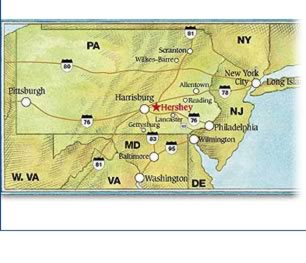
Actually, I didn't realize I would be "away" (from blogging that is). We just returned from spending the holiday with our families in Central Pennsylvania. I thought I'd have some time to blog while we were visiting. But as it turned out, we were much too busy.
My Roman friends might like to know that my oldest son and I attended a Christmas Eve Mass at a Roman Catholic parish -- St. Joan of Arc, Hershey, PA. The church was packed out! And it was only one of many services they were having that day. The service was a typical contemporary V-2 affair, and yes, I admit that I could not help musing that the Romans could learn a lot from the Episcopalians about how to "do" liturgy. But there is one thing the Romans seem to do right EVERY time I witness it, no matter what style of service (contemporary or traditional): the consecration of the elements. The solemnity of THAT moment was worth enduring all of the contemporary praise music beforehand. Even though I did not (and obviously could not) partake, I left that service fully nourished.
Until next time.
P.S. Blessed New Year to all my readers!
Monday, December 11, 2006
The "Catholica"

The Church which is "Jesus Christ spread abroad and communicated" completes -- so far as it can be completed here below -- the work of spiritual reunion which was made necessary by sin; that work which was begun at the Incarnation and was carried on up to Calvary. In one sense the Church is herself this reunion, for that is what is meant by the name of Catholic by which we find her called from the second century onward, and which in Latin as well as in Greek was for long bestowed upon her as a proper noun. Katholikos in classical Greek, was used by philosophers to indicate a universal proposition. Now a universal is a singular and is not to be confused with an aggregate. The Church is not Catholic because she is spread abroad over the whole of the earth and can reckon on a large number of members. She was already Catholic on the morning of Pentecost, when all her members could be contained in a small room, as she was when the Arian waves seemed on the point of swamping her; she would still be Catholic if tomorrow apostasy on a vast scale deprived her of almost all the faithful. For fundamentally Catholicity has nothing to do with geography or statistics. If it is true that it should be dsiplayed over all the earth and be manifest to all, yet its nature is not material but spiritual. Like sanctity, Catholicity is primarily an intrinsic feature of the Church.
--Henri de Lubac, Catholicism: Christ and the Common Destiny of Man (Ignatius Press), 48-9.
Tuesday, September 19, 2006
Henri de Lubac: The Obligation to Enter the Church

...For humanity taken as a whole, there can be no salvation outside the Church, that this is an absolute necessity, and a necessary means to which there can be no exception.
In this way the problem of the "salvation of unbelievers" receives a solution on the widest scale and at the same time no opening is left for compromising laxity. There is no encouragement to indifference. We see now how the Church can, in the words of a theologian, "be merciful to paganism without diminishing her proper character of being the only vehicle of salvation for souls"; and if it is thought that in spite of all these considerations the formula "outside the Church, no salvation" has still an ugly sound, there is no reason why it should not be put in a positive form and read, appealing to all men of good will, not "outside the Church you are damned", but "it is by the Church and by the Church alone that you will be saved". For it is through the Church that salvation will come, that it is already coming to mankind.
Of course the method of this salvation will differ according to whether the unbeliever has or has not encountered the Church. In the second case the only condition on which his salvation is possible is that he should be already a Catholic as it were by anticipation, since the Church is the "natural place" to which a soul amenable to the suggestion of grace spontaneously tends. The "less" is then sufficient -- to employ the expression for the last time -- not in itself, of it own worth, but insofar as it aspires to the "more", insofar as it is ready to be lost in this "more" directly the exterior obstacles which hide the "more" from it are removed.
--Catholicism: Christ and the Common Destiny of Man, pp. 235-37.
Saturday, September 16, 2006
A Generous Orthodoxy - But Not Necessarily of the McLaren Kind
Recently I published excerpts from two of the most prominent Roman Catholic theologians of the twentieth century: Henri de Lubac and Karl Rahner. Together their theological influence on the 2nd Vatican Council and post-conciliar theology has been immense. Consequently, the shadows of both theologians loom large over the monumental Catechism of the Catholic Church (1994). For example, De Lubac's positive re-formulation of St. Cyprian's dictum "Outside the Church, no salvation" (cf. Catechism, 846-848) has not only had profound implications for Rome's ecumenical endeavors, but upon her missiological ones as well (cf. 856). One can readily see Rahner's "anonymous Christian" alongside of De Lubac's optimistic take on humanity's common destiny. Rahner's influence also underlies the Cathechism's discussion of original sin, particularly in embracing Rahner's understanding of the analogical sense of "sin" in the classic statement of the doctrine (cf. 404, 405).
There is little question that, in retrospect, theologians of the 21st century will one day look back to the late 20th century as the Roman Church's most shining moment thus far. Not that there weren't problems or mistakes made along the way, but somehow, some way, the Roman Church of the 20th century was able to create a context for theological inquiry that I think can rightly be described as "a generous orthodoxy" (a phrase that Brian McLaren and the emergent church unfortunately threaten to turn into a cliche).
My own hypothesis is that this is the result of Rome's tenacious adherence to creedal and conciliar commitments (despite the filioque) combined with an openess to intellectual inquiry that permits her theologians to enter into constructive dialogue with modern advances in the sciences and other disciplines. In this way orthodox creedal and conciliar commitments serve as boundary markers establishing the wide perimeter within which the catholic theologian is free to explore and incorporate new discoveries of the world around us, which in turn helps in large part to illuminate and reinvigorate an ancient faith.
Ironically, once upon a time this was more the rule in Anglicanism than it was for Rome. In fact, I would go so far as to say that this was once a strength and characteristic peculiar and unique to Anglicanism. One need only compare Anglicanism's "generous orthodoxy" of the late 19th and early 20th centuries with the calicified post-Tridentine Roman Church of the same period. Indeed, my hunch (though I haven't done enough research yet to prove it) is that the reason behind Rome's dramatic and largely successful de-calcification of late was that it "stole" this particular page right out of the Anglican play-book, at the same time that, tragically, Anglicanism began to move, if not to ignore outright, the ancient boundary stones that once kept her from going astray.
Karl Rahner on Original Sin

"Original sin" in the Christian sense in no way implies that the original, personal act of freedom of the first person or persons is transmitted to us as our moral quality. In "original sin" the sin of Adam is not imputed to us. Personal guilt from an original act of freedom cannot be transmitted, for it is the existentiell [sic] "no" of personal transcendence towards God or against him. And by its very nature this cannot be transmitted, just as the formal freedom of a subject cannot be transmitted. This freedom is precisely the point where a person is unique and no one can take his place, where he cannot by analyzed away, as it were, either forwards or backwards or into his environment, and in this way escape responsibility for himself. For Catholic theology, therefore, "original sin" in no way means that the moral quality of the actions of the first person or persons is transmitted to us, whether this be through a juridical imputation by God or through some kind of biological heredity, however conceived.
In this connection it is obvious that when the word "sin" is used for the personal, evil decision of a subject, and when on the other hand it is applied to a sinful situation which derives from the decision of another, it is being used only in an analogous sense, and not in a univocal sense...
--Karl Rahner, Foundations of Christian Faith, p. 111
Friday, September 15, 2006
De Lubac on "The Role of Unbelievers"

...For since a necessary function in the history of our salvation was fulfilled by so great a mass of "unbelievers" -- not indeed in that they were in formal error or in a state of degradation, but in that there is to be found in their beliefs and consciences a certain groping after the truth, its painful preparation or its partial anticipation, discoveries of the natural reason and tentative solutions - so these unbelievers have an inevitable place in our humanity, a humanity such as the fall and the promise of a Redeemer have made it.
There is no comparison between their role and that of the scaffolding which, necessary as it is in the construction of a building, is discarded once the building is complete without further thought of what will become of it. For if the heavenly Jerusalem is built of living stones, it is also living beings that go to make its scaffolding. In other words, humanity is made up of persons who have all the same one eternal destiny, in whatever category or century their birth has placed them; their relationships cannot be envisaged, then, as just external ones, as if some existed only to prepare suitable conditions for the development of others, as in Renan's paradox of the coming of a superman. In spite of great differences of understanding and function, all members of the human race enjoy the same essential equality before God.
As "unbelievers" are, in the design of Providence, indispensable for building the Body of Christ, they must in their own way profit from their vital connection with this same Body. By an extension of the dogma of the communion of saints, it seems right to think that though they themselves are not in the normal way of salvation, they will be able nevertheless to obtain salvation by virtue of those mysterious bonds which unite them to the faithful. In short, they can be saved because they are an integral part of the humanity which is to be saved.
--Henri de Lubac, Catholicism: Christ and the Common Destiny of Man, pp. 232-233
Friday, September 01, 2006
Pope to debate evolution with students
I'm really looking forward to more news on this! Though I'm a little irked that the media continues to portray Intelligent Design theory as inimical to evolutionary processes. I would think that modern catholic thought on the subject (if not Benedict himself) may be seeking a way to merge the two ideas, an attempt which should be applauded.
The following article comes from The Australian. Biretta tip to Kendall and crew over at titusonenine.
By Tom Heneghan in Paris
August 30, 2006
POPE Benedict will gather some of his former theology students on Friday for a private weekend debate on evolution and religion, an issue conservative Christians have turned into a political cause in the United States.
Benedict, who taught theology at four German universities before rising in the Catholic Church hierarchy, has pondered weighty ideas with his former Ph.D students at annual meetings since the late 1970s without any media fuss.
But his election as pope last year and controversies over teaching evolution in the United States have aroused lively interest in this year's reunion on September 1-3 at the papal summer residence of Castel Gondolfo outside Rome.
Religion and science blogs are buzzing about whether it means the Vatican will take a more critical view of evolution and possibly embrace "Intelligent Design," which claims to have scientific proof that human life could not have simply evolved.
But Father Stephan Horn, a German theologian organising the pope's meeting with 39 former students, said that reflected a misunderstanding of how the so-called "student circle" works and what the Catholic Church teaches about evolution. "We've never drawn any conclusions in our student circle," he said. "This is an open exchange of ideas that does not aim for a conclusion.
"It has nothing to do with creationism," he added, referring to a fundamentalist Protestant view that God created the world in six days as described in the Book of Genesis. "Catholic theology does not endorse creationist views."
Subscribe to:
Posts (Atom)

