Despite the fact that I posted it almost two months ago, my last entry - "My Parish's Disaffilication with the ACC" - generated quite a lot of discussion of late. I thought I might see if we could continue the discussion in a new thread. My friend and former student, Fr. Jeffrey Steel, SSC entered the dialogue rather late in the game, and he has seen fit to take his old teacher to task. What follows are the questions he asked in his last response:
"Has heresy only become for you anything that is substantially denied in the Creeds?"
No, and I'm not certain where you got this idea. Certainly not from anything I have said on this blog or anywhere else. But note the distinction that I made in my last response to you between heresy and apostasy. In light of that distinction, perhaps a better question to have asked me is whether I think it possible for a church to be tolerant of heresy or even be formally in error at certain points of its teaching and STILL be regarded a true church. I think the self-evident Anglican answer to that question is: YES. This is essentially how Anglicans, since John Jewel and Richard Hooker, have regarded the Church of Rome, and in recent times, how those who deny the ordination of women somehow manage to remain in the Church of England.
"What sort of theological criteria do you use to define something as heretical?"
My theological criteria are very much like yours, I'm sure. My first appeal is to the consensus fidelium. This has been my approach for years, and is what I taught you in the classroom. In one of his responses to my earlier entry, Andy B. went so far as to issue a call for me to return to my "roots." Ironically, I've never left them.
"How far do the goal posts need to be moved before one is on another pitch?"
This is where that heresy/apostasy distinction comes in. I have stated on many occasions that something along the lines of a formal denial of the Trinity would indicate an irreversible departure from the faith and an indication that TEC was no longer a Christian church. It may not be an answer that satisfies you or Andy B., but it is an answer, and it's logically consistent with everything I have ever said on the matter.
But here's the rub: I at least have given an answer with a theological rationale. Apart from hearing the rhetoric that TEC has finally "gone too far," where are the goal posts for those who have or are anticipating leaving TEC?
Is apostasy merely a matter of how much heresy one is willing to tolerate before it becomes unbearable? Is TEC apostate because it has a gay bishop? Or because those who have left over Bishop Robinson simply cannot live in a church that has a gay bishop? Is TEC apostate because some heretical elements have gone so far as to endorse and/or authorize blessings of same sex relationships? Or is it that some simply cannot live in a church that is tolerant of those who endorse and/or authorize such blessings?
And when did/will the Church of England fall into apostasy? Over women priests? Over women bishops? Over gay priests/bishops? Over the official policy of the CoE that turns a blind eye to homosexual lay people who live in committed relationships? Over priests who undergo surgery for a sex-change? Over priests and bishops who are allowed under law to enter into "celibate" same sex unions? When? Where are your goal posts, Jeff?
+++++
NOTE TO READERS: Be sure to visit Father Jeffrey's excellent blog De Cura animarum.
Showing posts with label Ecclesiology. Show all posts
Showing posts with label Ecclesiology. Show all posts
Saturday, April 11, 2009


Sunday, July 20, 2008
Al Kimel's Comments on My Recent Entries

Below is a portion of a post written by Al Kimel over at Per Caritatem. This entry was excised from the discussion of my recent brief essays "Personal Reflections for Remaining in TEC," "The Problem of Confessionalism," and "Restating a Third Mill Catholic Prophecy." Biretta tip to Cynthia Nielsen for bringing these posts to the attention of her readers, and for maintaining the best theological blog in the blogosphere bar none. See link for the discussion below.
+++++++
I don’t believe that most who are really struggling with the present direction of the Episcopal Church will find Fr Daniel Dunlap’s reflections very helpful. Basically he seems to be saying, Episcopalians are all over the place theologically, but the TEC and Anglican Communion still formally retain catholic creeds and catholic orders, so there’s no imperative to break communion. As Fr Dunlap writes, “the only thing that really matters at the end of the day is the Church’s credo, not our individual “credos,” and endeavoring to live into it.”
This, of course, has been precisely the line advanced by most orthodox Episcopalians during the past thirty years. It is a failed strategy, and it ignores the political, theological, and ecclesial and seminary realities now confronting the “orthodox” (however one draws the lines of “orthodoxy”).
+++++++
First, I'll make a concession. Yes, Episcopalians are all over the place theologically, but then so are Roman Catholics. The difference? The Romans have in place a magisterium and a very nuanced rationale for doctrinal development that, when taken together, have so far managed to cover over centuries of theological missteps and still leave room for an infallible definition or two from time to time. However, they also make good hiding places for the "existentialist-expressivists" for whom Fr. Kimel apparently has no liking, and whom Fr. Kimel apparently would rather pretend did not exist within the Roman camp.
Be that as it may, the magisterium-doctrinal development thesis is so ingrained in the Roman psyche that to deny its catholicity (which I do) seemingly places its detractors on a playing field slanted in favor of those who affirm it. Okay, fair enough. I accept the premise that an "Anglican magisterium" would make Anglican life so much easier. But would it make Anglicanism more "catholic"? Would it solve the issues that so divide the Anglican Communion today? Or, rather, would it solidify for all time certain theological innovations in the name of "Anglican doctrinal development"? I believe the latter to be more likely, and I believe that supposedly "infallible" Roman dogmas (e.g., the Immaculate Conception) make the point better than I ever could.
Such a scenario, of course, is nonsensical. An "Anglican magisterium" is about as oxymoronic a term as one can imagine. However, my point should be obvious: the Anglican way of being "catholic" (or living into catholicity) is different than the Roman way. So why is it that Roman apologists (many of them ex-Anglicans, I might add) only come out to play when they have homefield advantage? Obviously it's futile to argue for the catholicity of Anglicanism on Roman terms. So I won't. I will be content to argue for the catholicity of Anglicanism on Anglican terms.
At first, it may appear odd to my readers to hear me suggest that Anglicanism has its "own terms" or definition of catholicity. But it shouldn't. I have argued on a number of occasions that each of the three major apostolic communions (i.e., Roman, Byzantine, Anglican) operate on quite different understandings of what it means to be "one, holy, catholic, and apostolic." Romanism and Byzantinism both make claims of ecclesial ultimacy. But their respective claims are mutually exclusive, as the former insists on papal supremacy and the latter on the received faith of the ecumenical councils. Thus, despite whatever superficial similarities Rome and Byzantium may have, they are different ways of understanding what it means to be catholic. In contrast, Anglicanism has never made a claim of ecclesial ultimacy, and so defines itself not as the Catholic Church, but rather as a catholic church, and thus recognizes the other two communions as legitimate branches of "the one, holy, catholic, and apostolic Church." Unlike Fr. Kimel, I see this as Anglicanism's greatest strength, not its weakness. And if it survives the present struggles, then it will only be that much stronger.
You see, believe it or not, I still believe in "common prayer catholicity," which, contrary to Al Kimel's reductionism above, is more than just the formal retention of ancient creeds and apostolic orders. Neither is my position merely a "strategy," failed or otherwise, for the orthodox to stay put in TEC/Anglican Communion. I don't need a reason or a strategy to stay in TEC. Indeed, the burden of proof is STILL on those who insist that I should leave! Rather Anglicanism is a way of being catholic, or living into catholicity, that has proven itself very effective and extremely resilient over the last nearly 500 years of this independent Anglican experiment. I still believe that Anglicanism is a movement of God. I may be wrong. But why should I give up on it now?
Per Caritatem
Monday, January 22, 2007
Karl Barth's comment on the plurality of churches

I pulled this quote of Karl Barth from Hans Urs von Balthasar's article on A Divided Church (see below). Barth's comments stand on their own as a classic appraisal of our current divisions, and so are worthy of our consideration.
++++++++++++++++
The plurality of churches ... should not be interpreted as something willed by God, as a normal unfolding of the wealth of grace given to mankind in Jesus Christ [nor as] a necessary trait of the visible, empirical Church, in contrast to the invisible, ideal, essential Church. Such a distinction is entirely foreign to the New Testament because, in this regard also, the Church of Jesus Christ is one. She is invisible in terms of the grace of the Word of God and of the Holy Spirit, . . . but visible in signs in the multitude of those who profess their adherence to her; she is visible as a community and in her community ministry, visible in her service of the word and sacrament.... It is impossible to escape from the visible Church to the invisible.
If ecumenical endeavor is pursued along the lines of such a distinction, however fine the words may sound, it is philosophy of history and philosophy of society. it is not theology. People who do this are producing their own ideas in order to get rid of the question of the Church's unity, instead of facing the question posed by Christ.... If we listen to Christ, . we do not exist above the differences that divide the Church: we exist in them.... In fact, we should not attempt to explain the plurality of churches at all. We should treat it as we treat our sins and those of others.... We should understand the plurality as a mark of our guilt (K. Barth, Die Kirche und die Kirchen. Theol., 9- 10).
Saturday, January 20, 2007
A Divided Church? by Hans Urs von Balthasar
There's much in here that I like (particularly the quote from Barth), but it's interesting to see how this eminent theologian struggles with this issue.

A Divided Church?
by Hans Urs von Balthasar
from the Third Volume of the Theo-Dramatic
The division of the Church, brought about by sin, is rendered all the easier because of the distribution within her of various charisms and offices. At the very outset the community must be warned against envy and jealousy: someone else has been given something I do not possess; but, in the dispensation of love, it is for the greatest advantage of the whole in which I share. The eye sees on behalf of the whole body, and so on (1 Cor 12).
The administration of charisms presupposes selfless love on the part of all (1Cor 13). It takes only the slightest change of perspective to highlight the special nature of a charism--perhaps its striking and attractive side-making it seem more important than the Church's organic unity. Thus parties arise, often through no fault of the bearers of charisms. So Paul exhorts his hearers: "I appeal to you, brethren.... that there be no dissensions [schismata] among you, but that you be united in the same mind and the same judgment. For it has been reported to me ... that there is quarrelling among you, my brethren. What I mean is that each one of you says, 'I belong to Paul', or 'I belong to Apollos', or 'I belong to Cephas. . . .' Is Christ divided? Was Paul crucified for you?" (1 Cor 1: 10-13).
Of course, there is a difference between schisms within the Church and the ultimate schism that separates people from the unity of the institutional Church. But there can be no doubt that the former were the cause of the latter. Sin in the Church is the origin of the (equally sinful) separation from the Church. The process can last for hundreds of years within the Church--think of the long prelude to the schism with the East and to the Reformation--but it can always be traced back.
Not that this justifies the ultimate rupture. A slackening of the love that preserves and builds up the Church's catholicity is the beginning, however hidden, of all division in the Church: ‘ubi peccata, ibi multitudo.’ ‘Where there are sins. there is multiplicity, divisions, erroneous teachings and discord. But where there is virtue, there is oneness, union; thus all believers were 'of one heart and one soul'. (Origen, In Ez. hom. 9)
This raises the grave question whether, and when, the Church, divided internally and often externally as well, ceases to be a single person in the theo-drama. Two principles are crucial here. The first is that the Church, both as a community of saints and as an institution, is designed and equipped to sustain and save the sinners who dwell within her; she is *corpus permixtum* and must not separate herself from them as a Church of the "pure", elect", "predestined", and so forth.
To that extent, she has to continue to endure the inner tension between her ideal and her fallen reality, endeavoring to draw what is at her periphery toward the center. Thus the unity that encompasses her (the "net") is a principle of this kind: it can hold on to those who are estranged from her provided they have not deliberately renounced her.
At this borderline, however, the other principle takes over: theologically speaking, there absolutely cannot be a plurality of Churches of Christ; if such a plurality empirically exists, these several Christian churches cannot represent theological "persons". It follows that it is impossible, by a process of abstraction, to deduce some common denominator from the historical plurality and so posit an overall concept of the one Church; for the latter's unity is not that of a species: it is a concrete and individual, unique unity, corresponding to the unique Christ who founded her.
We would do well to listen to Karl Barth at this point:
‘The plurality of churches ... should not be interpreted as something willed by God, as a normal unfolding of the wealth of grace given to mankind in Jesus Christ [nor as] a necessary trait of the visible, empirical Church, in contrast to the invisible, ideal, essential Church. Such a distinction is entirely foreign to the New Testament because, in this regard also, the Church of Jesus Christ is one. She is invisible in terms of the grace of the Word of God and of the Holy Spirit, . . . but visible in signs in the multitude of those who profess their adherence to her; she is visible as a community and in her community ministry, visible in her service of the word and sacrament.... It is impossible to escape from the visible Church to the invisible.
'If ecumenical endeavor is pursued along the lines of such a distinction, however fine the words may sound, it is philosophy of history and philosophy of society. it is not theology. People who do this are producing their own ideas in order to get rid of the question of the Church's unity, instead of facing the question posed by Christ.... If we listen to Christ, . we do not exist above the differences that divide the Church: we exist in them.... In fact, we should not attempt to explain the plurality of churches at all. We should treat it as we treat our sins and those of others.... We should understand the plurality as a mark of our guilt’ (K. Barth, Die Kirche und die Kirchen. Theol., 9- 10).
We search the New Testament in vain, therefore, if we are looking for guidelines as to how separated churches should get on together; all we shall find there are instructions for avoiding such divisions.
While it is possible to say, with the Second Vatican Council, that "some, even very many, of the most significant elements and endowments that together go to build up and give life to the Church herself can exist" in those Christian communities that have deliberately distanced themselves from the institution of the Catholica; and while we may recognize that "men who believe in Christ and have been properly baptized are put in some, though imperfect, communion with the Catholic Church", this does not mean that such communities constitute separate theological persons over against the Catholica.
With regard to the relationship between the Roman Catholic and Orthodox Churches, the question is whether mutual estrangement has proceeded so far that we are obliged to speak of two "Churches", or whether, in point of historical fact, unity "has never ceased to exist at a deep level" (L. Bouyer, The Church of God: "Theology of the Church").
There have also been attempts to suggest that there is a theological ‘necessity’ behind the phenomenon of schisms, ‘whether on the basis of the Old Testament schism between the North and South Kingdoms’ or arising out of the ‘primal split’ between Judaism and the Gentile world at the founding of the Church. With regard to the former split, however, the tribes of Israel had never been a unity comparable to that of the Body of Christ but a ‘confederation of diverse tribal groups’ that had only lately been united ‘in the person’ of the monarch. With regard to the latter split, it would be difficult to maintain that the Israel that refused Christ was responsible for disputes within the Christian Church; according to Paul, the unity of Christians is based on an entirely different principle (Eph 4:3 ff.) from that of the Jewish ‘sects’ (and Paul had been a member of one of them).
Precisely this principle of unity, however--the Eucharist of the pneumatic Lord--is a wholly new and incomparable principle, and this makes the initial split, which becomes aggravated into full-blown schism, to be practically irreversible. Urged by the most elementary sense of Christian duty, the ‘ecumenical movement’ must indeed tirelessly exert itself for the reunion of the separated ‘churches’. By doing this many partial successes can doubtless be achieved: for instance, the reduction of mutual misunderstandings, suspicions and denigrations.
But the fact remains that the group of churches separated from the Catholic Church has, by this very separation, necessarily gotten rid of the visible symbol of unity, the papacy, and this results in a situation in which our partners in dialogue (including the Orthodox) do not possess any authority which is recognized by all the believers and as such can officially represent these. In each case we are dealing with individual groups or bishops who regularly divide themselves into a party of agreement and a party of objection whenever reunion with the Catholic Church is contemplated. And, seemingly, the best that such groups can produce is an offer of abstract catholicity arrived at by overlooking real differences. We have already described such ‘catholicity’ as being plainly unacceptable.
However fruitful and instructive the ecumenical dialogue between Churches is, exemplary holiness will show not only that obedience to the Church (as understood by Catholics) can be integrated into Christian *agape* but that it is actually an indispensable part of the latter and of the discipleship of Christ.
Finally, while the Church's missionary task is to give witness to the world, the chimera of the divided Church shows just how shaky her self-transcendence into the world is. Indeed, it becomes increasingly precarious, the more Christian sects proliferate. Even if the worst stumbling blocks were overcome by making pacts between missions professing different beliefs, the fundamental stumbling block would remain as far as the recipient of missionary activity is concerned.
Nor can it be removed by portraying the diversity of Christian expressions as something harmless, something arising necessarily as a result of historical development, or even as something that brings blessing. To do this would simply be to obscure Jesus' original wish even more. To repeat the words of Karl Barth on the phenomenon of division in the Church: ‘We should treat it as we treat our sins and those of others.’"
by Hans Urs von Balthasar
from the Third Volume of the Theo-Dramatic
The division of the Church, brought about by sin, is rendered all the easier because of the distribution within her of various charisms and offices. At the very outset the community must be warned against envy and jealousy: someone else has been given something I do not possess; but, in the dispensation of love, it is for the greatest advantage of the whole in which I share. The eye sees on behalf of the whole body, and so on (1 Cor 12).
The administration of charisms presupposes selfless love on the part of all (1Cor 13). It takes only the slightest change of perspective to highlight the special nature of a charism--perhaps its striking and attractive side-making it seem more important than the Church's organic unity. Thus parties arise, often through no fault of the bearers of charisms. So Paul exhorts his hearers: "I appeal to you, brethren.... that there be no dissensions [schismata] among you, but that you be united in the same mind and the same judgment. For it has been reported to me ... that there is quarrelling among you, my brethren. What I mean is that each one of you says, 'I belong to Paul', or 'I belong to Apollos', or 'I belong to Cephas. . . .' Is Christ divided? Was Paul crucified for you?" (1 Cor 1: 10-13).
Of course, there is a difference between schisms within the Church and the ultimate schism that separates people from the unity of the institutional Church. But there can be no doubt that the former were the cause of the latter. Sin in the Church is the origin of the (equally sinful) separation from the Church. The process can last for hundreds of years within the Church--think of the long prelude to the schism with the East and to the Reformation--but it can always be traced back.
Not that this justifies the ultimate rupture. A slackening of the love that preserves and builds up the Church's catholicity is the beginning, however hidden, of all division in the Church: ‘ubi peccata, ibi multitudo.’ ‘Where there are sins. there is multiplicity, divisions, erroneous teachings and discord. But where there is virtue, there is oneness, union; thus all believers were 'of one heart and one soul'. (Origen, In Ez. hom. 9)
This raises the grave question whether, and when, the Church, divided internally and often externally as well, ceases to be a single person in the theo-drama. Two principles are crucial here. The first is that the Church, both as a community of saints and as an institution, is designed and equipped to sustain and save the sinners who dwell within her; she is *corpus permixtum* and must not separate herself from them as a Church of the "pure", elect", "predestined", and so forth.
To that extent, she has to continue to endure the inner tension between her ideal and her fallen reality, endeavoring to draw what is at her periphery toward the center. Thus the unity that encompasses her (the "net") is a principle of this kind: it can hold on to those who are estranged from her provided they have not deliberately renounced her.
At this borderline, however, the other principle takes over: theologically speaking, there absolutely cannot be a plurality of Churches of Christ; if such a plurality empirically exists, these several Christian churches cannot represent theological "persons". It follows that it is impossible, by a process of abstraction, to deduce some common denominator from the historical plurality and so posit an overall concept of the one Church; for the latter's unity is not that of a species: it is a concrete and individual, unique unity, corresponding to the unique Christ who founded her.
We would do well to listen to Karl Barth at this point:
‘The plurality of churches ... should not be interpreted as something willed by God, as a normal unfolding of the wealth of grace given to mankind in Jesus Christ [nor as] a necessary trait of the visible, empirical Church, in contrast to the invisible, ideal, essential Church. Such a distinction is entirely foreign to the New Testament because, in this regard also, the Church of Jesus Christ is one. She is invisible in terms of the grace of the Word of God and of the Holy Spirit, . . . but visible in signs in the multitude of those who profess their adherence to her; she is visible as a community and in her community ministry, visible in her service of the word and sacrament.... It is impossible to escape from the visible Church to the invisible.
'If ecumenical endeavor is pursued along the lines of such a distinction, however fine the words may sound, it is philosophy of history and philosophy of society. it is not theology. People who do this are producing their own ideas in order to get rid of the question of the Church's unity, instead of facing the question posed by Christ.... If we listen to Christ, . we do not exist above the differences that divide the Church: we exist in them.... In fact, we should not attempt to explain the plurality of churches at all. We should treat it as we treat our sins and those of others.... We should understand the plurality as a mark of our guilt’ (K. Barth, Die Kirche und die Kirchen. Theol., 9- 10).
We search the New Testament in vain, therefore, if we are looking for guidelines as to how separated churches should get on together; all we shall find there are instructions for avoiding such divisions.
While it is possible to say, with the Second Vatican Council, that "some, even very many, of the most significant elements and endowments that together go to build up and give life to the Church herself can exist" in those Christian communities that have deliberately distanced themselves from the institution of the Catholica; and while we may recognize that "men who believe in Christ and have been properly baptized are put in some, though imperfect, communion with the Catholic Church", this does not mean that such communities constitute separate theological persons over against the Catholica.
With regard to the relationship between the Roman Catholic and Orthodox Churches, the question is whether mutual estrangement has proceeded so far that we are obliged to speak of two "Churches", or whether, in point of historical fact, unity "has never ceased to exist at a deep level" (L. Bouyer, The Church of God: "Theology of the Church").
There have also been attempts to suggest that there is a theological ‘necessity’ behind the phenomenon of schisms, ‘whether on the basis of the Old Testament schism between the North and South Kingdoms’ or arising out of the ‘primal split’ between Judaism and the Gentile world at the founding of the Church. With regard to the former split, however, the tribes of Israel had never been a unity comparable to that of the Body of Christ but a ‘confederation of diverse tribal groups’ that had only lately been united ‘in the person’ of the monarch. With regard to the latter split, it would be difficult to maintain that the Israel that refused Christ was responsible for disputes within the Christian Church; according to Paul, the unity of Christians is based on an entirely different principle (Eph 4:3 ff.) from that of the Jewish ‘sects’ (and Paul had been a member of one of them).
Precisely this principle of unity, however--the Eucharist of the pneumatic Lord--is a wholly new and incomparable principle, and this makes the initial split, which becomes aggravated into full-blown schism, to be practically irreversible. Urged by the most elementary sense of Christian duty, the ‘ecumenical movement’ must indeed tirelessly exert itself for the reunion of the separated ‘churches’. By doing this many partial successes can doubtless be achieved: for instance, the reduction of mutual misunderstandings, suspicions and denigrations.
But the fact remains that the group of churches separated from the Catholic Church has, by this very separation, necessarily gotten rid of the visible symbol of unity, the papacy, and this results in a situation in which our partners in dialogue (including the Orthodox) do not possess any authority which is recognized by all the believers and as such can officially represent these. In each case we are dealing with individual groups or bishops who regularly divide themselves into a party of agreement and a party of objection whenever reunion with the Catholic Church is contemplated. And, seemingly, the best that such groups can produce is an offer of abstract catholicity arrived at by overlooking real differences. We have already described such ‘catholicity’ as being plainly unacceptable.
However fruitful and instructive the ecumenical dialogue between Churches is, exemplary holiness will show not only that obedience to the Church (as understood by Catholics) can be integrated into Christian *agape* but that it is actually an indispensable part of the latter and of the discipleship of Christ.
Finally, while the Church's missionary task is to give witness to the world, the chimera of the divided Church shows just how shaky her self-transcendence into the world is. Indeed, it becomes increasingly precarious, the more Christian sects proliferate. Even if the worst stumbling blocks were overcome by making pacts between missions professing different beliefs, the fundamental stumbling block would remain as far as the recipient of missionary activity is concerned.
Nor can it be removed by portraying the diversity of Christian expressions as something harmless, something arising necessarily as a result of historical development, or even as something that brings blessing. To do this would simply be to obscure Jesus' original wish even more. To repeat the words of Karl Barth on the phenomenon of division in the Church: ‘We should treat it as we treat our sins and those of others.’"
Tuesday, January 16, 2007
The Visible Church: My continuing conversation with "Anonymous"

ANON: "One" in what way? If you offer with the vague "in Christ", it is eerily similar to "invisible Church".
LEXORANDI2: The invisible Church model, originating with the Lutherans, makes personal faith or belief determinative of one’s membership in the Church. In such a model, the visible Church and her sacraments are secondary and non-determinative. All that counts is one’s personal faith. Thus you are right be concerned about this.
But that is not what I’m saying at all. Rather, baptism – a visible sign – is the determinative boundary of the Church. One is either baptized or not, and with the claim of baptism comes the responsibility to assent to the Church’s faith and teaching, which includes continuing “in the apostles’ teaching and fellowship, in the breaking of bread, and in the prayers.”
When I, as an Anglican, confess my “oneness” with the Roman Catholic or the Eastern Orthodox adherent I confess primarily a common baptism and a common faith (i.e., the Faith of the Church Catholic articulated in the Creed). But with this confession is also my affirmation that the respective ecclesial communities to which they belong are true, visible churches – part of the “one Church” that I confess in the Creed.
I suspect that your discomfort with the Anglican position (at least THIS Anglican’s position) is not only the explicit recognition of other apostolically-constituted churches (e.g., Roman Catholic, Orthodox), but also that other communities, whose apostolic pedigrees may be in question, are not explicitly “unrecognized.” I can only respond with something that a wise Eastern Orthodox priest once told me, “We can show you where the Church is, but we cannot always show you where it is not.” That Anglicans tend to err on the side of charity with respect to non-episcopal bodies is readily to be admitted. But I tend to see that as a virtue, not a vice.
LEXORANDI2: The invisible Church model, originating with the Lutherans, makes personal faith or belief determinative of one’s membership in the Church. In such a model, the visible Church and her sacraments are secondary and non-determinative. All that counts is one’s personal faith. Thus you are right be concerned about this.
But that is not what I’m saying at all. Rather, baptism – a visible sign – is the determinative boundary of the Church. One is either baptized or not, and with the claim of baptism comes the responsibility to assent to the Church’s faith and teaching, which includes continuing “in the apostles’ teaching and fellowship, in the breaking of bread, and in the prayers.”
When I, as an Anglican, confess my “oneness” with the Roman Catholic or the Eastern Orthodox adherent I confess primarily a common baptism and a common faith (i.e., the Faith of the Church Catholic articulated in the Creed). But with this confession is also my affirmation that the respective ecclesial communities to which they belong are true, visible churches – part of the “one Church” that I confess in the Creed.
I suspect that your discomfort with the Anglican position (at least THIS Anglican’s position) is not only the explicit recognition of other apostolically-constituted churches (e.g., Roman Catholic, Orthodox), but also that other communities, whose apostolic pedigrees may be in question, are not explicitly “unrecognized.” I can only respond with something that a wise Eastern Orthodox priest once told me, “We can show you where the Church is, but we cannot always show you where it is not.” That Anglicans tend to err on the side of charity with respect to non-episcopal bodies is readily to be admitted. But I tend to see that as a virtue, not a vice.
Tuesday, September 19, 2006
Henri de Lubac: The Obligation to Enter the Church

...For humanity taken as a whole, there can be no salvation outside the Church, that this is an absolute necessity, and a necessary means to which there can be no exception.
In this way the problem of the "salvation of unbelievers" receives a solution on the widest scale and at the same time no opening is left for compromising laxity. There is no encouragement to indifference. We see now how the Church can, in the words of a theologian, "be merciful to paganism without diminishing her proper character of being the only vehicle of salvation for souls"; and if it is thought that in spite of all these considerations the formula "outside the Church, no salvation" has still an ugly sound, there is no reason why it should not be put in a positive form and read, appealing to all men of good will, not "outside the Church you are damned", but "it is by the Church and by the Church alone that you will be saved". For it is through the Church that salvation will come, that it is already coming to mankind.
Of course the method of this salvation will differ according to whether the unbeliever has or has not encountered the Church. In the second case the only condition on which his salvation is possible is that he should be already a Catholic as it were by anticipation, since the Church is the "natural place" to which a soul amenable to the suggestion of grace spontaneously tends. The "less" is then sufficient -- to employ the expression for the last time -- not in itself, of it own worth, but insofar as it aspires to the "more", insofar as it is ready to be lost in this "more" directly the exterior obstacles which hide the "more" from it are removed.
--Catholicism: Christ and the Common Destiny of Man, pp. 235-37.
Saturday, September 16, 2006
A Generous Orthodoxy - But Not Necessarily of the McLaren Kind
Recently I published excerpts from two of the most prominent Roman Catholic theologians of the twentieth century: Henri de Lubac and Karl Rahner. Together their theological influence on the 2nd Vatican Council and post-conciliar theology has been immense. Consequently, the shadows of both theologians loom large over the monumental Catechism of the Catholic Church (1994). For example, De Lubac's positive re-formulation of St. Cyprian's dictum "Outside the Church, no salvation" (cf. Catechism, 846-848) has not only had profound implications for Rome's ecumenical endeavors, but upon her missiological ones as well (cf. 856). One can readily see Rahner's "anonymous Christian" alongside of De Lubac's optimistic take on humanity's common destiny. Rahner's influence also underlies the Cathechism's discussion of original sin, particularly in embracing Rahner's understanding of the analogical sense of "sin" in the classic statement of the doctrine (cf. 404, 405).
There is little question that, in retrospect, theologians of the 21st century will one day look back to the late 20th century as the Roman Church's most shining moment thus far. Not that there weren't problems or mistakes made along the way, but somehow, some way, the Roman Church of the 20th century was able to create a context for theological inquiry that I think can rightly be described as "a generous orthodoxy" (a phrase that Brian McLaren and the emergent church unfortunately threaten to turn into a cliche).
My own hypothesis is that this is the result of Rome's tenacious adherence to creedal and conciliar commitments (despite the filioque) combined with an openess to intellectual inquiry that permits her theologians to enter into constructive dialogue with modern advances in the sciences and other disciplines. In this way orthodox creedal and conciliar commitments serve as boundary markers establishing the wide perimeter within which the catholic theologian is free to explore and incorporate new discoveries of the world around us, which in turn helps in large part to illuminate and reinvigorate an ancient faith.
Ironically, once upon a time this was more the rule in Anglicanism than it was for Rome. In fact, I would go so far as to say that this was once a strength and characteristic peculiar and unique to Anglicanism. One need only compare Anglicanism's "generous orthodoxy" of the late 19th and early 20th centuries with the calicified post-Tridentine Roman Church of the same period. Indeed, my hunch (though I haven't done enough research yet to prove it) is that the reason behind Rome's dramatic and largely successful de-calcification of late was that it "stole" this particular page right out of the Anglican play-book, at the same time that, tragically, Anglicanism began to move, if not to ignore outright, the ancient boundary stones that once kept her from going astray.
There is little question that, in retrospect, theologians of the 21st century will one day look back to the late 20th century as the Roman Church's most shining moment thus far. Not that there weren't problems or mistakes made along the way, but somehow, some way, the Roman Church of the 20th century was able to create a context for theological inquiry that I think can rightly be described as "a generous orthodoxy" (a phrase that Brian McLaren and the emergent church unfortunately threaten to turn into a cliche).
My own hypothesis is that this is the result of Rome's tenacious adherence to creedal and conciliar commitments (despite the filioque) combined with an openess to intellectual inquiry that permits her theologians to enter into constructive dialogue with modern advances in the sciences and other disciplines. In this way orthodox creedal and conciliar commitments serve as boundary markers establishing the wide perimeter within which the catholic theologian is free to explore and incorporate new discoveries of the world around us, which in turn helps in large part to illuminate and reinvigorate an ancient faith.
Ironically, once upon a time this was more the rule in Anglicanism than it was for Rome. In fact, I would go so far as to say that this was once a strength and characteristic peculiar and unique to Anglicanism. One need only compare Anglicanism's "generous orthodoxy" of the late 19th and early 20th centuries with the calicified post-Tridentine Roman Church of the same period. Indeed, my hunch (though I haven't done enough research yet to prove it) is that the reason behind Rome's dramatic and largely successful de-calcification of late was that it "stole" this particular page right out of the Anglican play-book, at the same time that, tragically, Anglicanism began to move, if not to ignore outright, the ancient boundary stones that once kept her from going astray.
Sunday, May 14, 2006
Anglican and Orthodox Differences in Ecclesiology
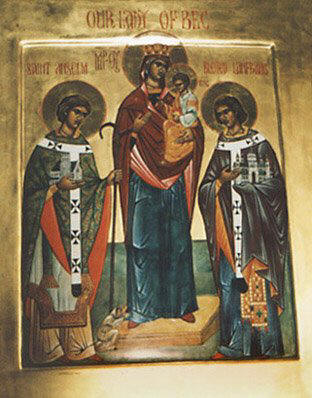
I found this helpful statement, which I think captures the heart of the issue, in an article by Fr. John Daly, a former Episcopalian turned Eastern Orthodox. The link is provided below:
"...While we agree that the Church is one, holy, catholic and apostolic, we are not agreed on the account to be given of the sinfulness and division which is to be observed in the life of Christian communities. For Anglicans, because the Church under Christ it is the community where God’s grace is at work, healing and transforming sinful men and women; and because grace in the Church is mediated through those who are themselves undergoing such transformation, the struggle between grace and sin is seen as characteristic of, rather than accidental to, the Church on earth. Orthodox while agreeing that the human members of the Church on earth are sinful, do not believe that sinfulness should be ascribed to the Church as the Body of Christ indwelt by the Holy Spirit."
(Problems of Ecclesiology between Anglicans and Orthodox in the Dublin Agreed Statement, 1984. See http://www.westernorthodox.com/daly)
Thursday, April 06, 2006
Food for thought from Barth

There are tremendous implications here for how we understand the Nicene confession of "one, holy, catholic, and apostolic Church," don't you think?If by the concept of a "true religion" we mean truth which belongs to
religion in itself and as such, it is just as unattainable as a "good man,"
if by goodness we mean something which man can achieve on his own
initiative. No religion is true. It can only become true. ...And it can
become true only in a way in which man is justified, from without...Like justified man, religion is a creature of grace.(Church Dogmatics, I, 2, p. 325-326)
Subscribe to:
Comments (Atom)


