See The Pain.
Warning: language may be offensive to more sensitive audiences.
Showing posts with label Creationism. Show all posts
Showing posts with label Creationism. Show all posts
Tuesday, April 28, 2009


Monday, April 27, 2009
Evolution and Incarnation
The following excerpt was taken from an article by Roland over at his blog Two Natures. I found it insightful.
Evolution and the Incarnation
In a stereotypical creationist-vs.-atheist debate, I have no one to root for. Both sides have already lost me before the debate even begins. Once the debate is joined, it looks like they disagree on every single point, and that is how they are usually perceived. To me, however, it seems that they agree with each other on the central premise that underlies the debate: in the provocative form attributed to Richard Dawkins, "If Darwin's cosmology was right, then theology is senseless babble." And creationists like Phillip Johnson accept the premise and join the debate on those terms. This all-or-nothing proposition, for those who accept it, validates both the conflict and the energy they expend on it.
When combatants on both sides find a rare proposition they can agree on, one is tempted to let it pass without further examination. But this premise is both illogical and heretical. It assumes that God's only purpose is to serve as a causal explanation of phenomena in the physical universe, and that if a completely natural explanation can be found for every phenomenon then we can dispense with God as redundant and dismiss the supernatural entirely. This argument might be compatible with a Deistic "God of the gaps," but it cannot be reconciled with the God of orthodox Christianity. We believe that Jesus was both fully divine and fully human – that these two natures dwelt in him without contradiction. From this orthodox Christian understanding of the Incarnation, it follows that the supernatural is not excluded by the natural; rather, the supernatural manifests itself in and through the natural. Therefore, even if science were somehow to demonstrate the truth of an entirely materialistic explanation of the universe, it could not exclude the existence or activity of God.
Therefore, from an orthodox Christian point of view, a debate premised on the mutual exclusivity of the natural and the supernatural is flawed from the outset.
Evolution and the Incarnation
In a stereotypical creationist-vs.-atheist debate, I have no one to root for. Both sides have already lost me before the debate even begins. Once the debate is joined, it looks like they disagree on every single point, and that is how they are usually perceived. To me, however, it seems that they agree with each other on the central premise that underlies the debate: in the provocative form attributed to Richard Dawkins, "If Darwin's cosmology was right, then theology is senseless babble." And creationists like Phillip Johnson accept the premise and join the debate on those terms. This all-or-nothing proposition, for those who accept it, validates both the conflict and the energy they expend on it.
When combatants on both sides find a rare proposition they can agree on, one is tempted to let it pass without further examination. But this premise is both illogical and heretical. It assumes that God's only purpose is to serve as a causal explanation of phenomena in the physical universe, and that if a completely natural explanation can be found for every phenomenon then we can dispense with God as redundant and dismiss the supernatural entirely. This argument might be compatible with a Deistic "God of the gaps," but it cannot be reconciled with the God of orthodox Christianity. We believe that Jesus was both fully divine and fully human – that these two natures dwelt in him without contradiction. From this orthodox Christian understanding of the Incarnation, it follows that the supernatural is not excluded by the natural; rather, the supernatural manifests itself in and through the natural. Therefore, even if science were somehow to demonstrate the truth of an entirely materialistic explanation of the universe, it could not exclude the existence or activity of God.
Therefore, from an orthodox Christian point of view, a debate premised on the mutual exclusivity of the natural and the supernatural is flawed from the outset.
Sunday, August 10, 2008
Interesting Quote
"It is often attempted to palliate slavery by comparing the state of slaves with our poorer countrymen: if the misery of our poor be caused not by the laws of nature, but by our institutions, great is our sin; but how this bears on slavery, I cannot see; as well might the use of the thumb-screw be defended in one land, by showing that men in another land suffered from some dreadful disease. Those who look tenderly at the slave owner, and with a cold heart at the slave, never seem to put themselves into the position of the latter; what a cheerless prospect, with not even a hope of change! picture to yourself the chance, ever hanging over you, of your wife and your little children -- those objects which nature urges even the slave to call his own -- being torn from you and sold like beasts to the first bidder! And these deeds are done and palliated by men, who profess to love their neighbours as themselves, who believe in God, and pray that his Will be done on earth! It makes one's blood boil, yet heart tremble, to think that we Englishmen and our American descendants, with their boastful cry of liberty, have been and are so guilty."
--Charles Darwin, Voyage of the Beagle (1839)
--Charles Darwin, Voyage of the Beagle (1839)
Friday, August 24, 2007
The Inconsistent Logic of Creationism or Why Creationism is Essentially Deistic

...At the heart of their anti-evolutionism, the creationists have hidden a stunning inconsistency in their own logic.
Consider this: Creationists would reject any notion that God is unable to act in the world today. Indeed Christianity, like Islam and traditional Judaism, regards the continued, personal activity of God to be an essential element of belief. Now, let's step back a bit and think about this.
As a matter of unshakable faith, they believe that God can act in the world at the present time. And that, presumably, He can work His will in any way He likes -- with power or with subtlety, by works of nature, or by the individual actions of His creatures. The very same people, bowing to the explanatory power of molecular biology and biochemistry, would also agree that life today can be understood as a wholly material phenomenon. None that I know of would reject the proposition that a single fertilized egg cell -- the classic specimen of developmental biology -- contains the full and complete set of instructions to transform itself into a complex multi-cellular organism. Neither would any respectable creationist challenge the assertion that every step of that developmental process is ultimately explicable in terms of the material processes of chemistry and physics. Miracles aren't required -- the complexities of molecular biology will do just fine.
This means that the biological world of today, which we can test and study, analyze and dissect, is one that works according to purely material rules. But this world is also one in which believers, as a matter of faith, accept sincerely the tenet that God can and does work His will. Obviously, they do not see any conflict in the idea that God can carry out the work He chooses to in a way that is consistent with the fully materialist view of biology that emerges from contemporary biology. Neither do I.
But there's the rub. Curiously, they somehow regard those very same mechanisms -- adequate to explain God's power in the present -- as inadequate to explain His agency in the past. For some reason, God acted in the past in ways that He does not act in the present, despite the fact that we assume in the present that he can do anything and everything. This inconsistent reasoning is at the heart of their desperation to show that evolution -- which depends on the material mechanisms of biochemistry and genetics -- could not have created the multitude of new species that have appeared throughout the geologic record of life.
Such reasoning shows a curious lack of faith in the creative power of God. Creationists act as though compelled to go into the past for evidence of God's work, yet ridicule the deistic notion of a designer-God who's been snoozing ever since His great work was finished. They want a God who is active, and active now. So does any believer. But why then are they so determined to fix in the past, in the supposed impossibility of material mechanisms to originate species, the only definitive signs of God's work? If they believe in an active and present God, a God who can work His will in the present in ways consistent with scientific materialism, then why couldn't that same God have worked His will in exactly those ways in the past?
The more sensible and self-consistent position, scientifically and theologically, would be quite different from theirs. The real, actual, working world that we see around us is one that is ruled by chemistry and physics. Life works according to its laws. If God is real, this is the world He has to work in. Therefore any effort to view God's work in light of modern science must find a way to understand how His will can be accommodated at all times, not just in some distant past.
--Kenneth Miller, Finding Darwin's God (New York: Harper Perennial, 2007), 216-18.
Thursday, June 21, 2007
Science and Eastern Orthodoxy
LINK
LIGHT FROM THE EAST: Theology, Science and the Eastern Orthodox Tradition
by Alexei V. Nesteruk
Fortress Press (2003)
In the non-Orthodox world, a lively dialogue between science and theology has been taking place for decades. Among Orthodox, however, the theological response to modern scientific theory has hitherto been extremely muted. It has therefore been with great anticipation that they have awaited the study by Alexei Nesteruk which has now been published. For Nesteruk, as well as being a member of the Orthodox Church, is also a researcher at the University of Portsmouth, and, as such, he is someone who can speak of the scientific enterprise from within.
As a mathematical physicist, Nesteruk has clearly decided to stick to those aspects of science that he knows well. Some might regard this as a pity, since it leads him to ignore almost entirely the theological questions arising from some of the aspects of modern scientific theory that Christians tend to find the most disturbing, such as neo-Darwinism. This is, however, less of a problem that might appear at first sight, since Nesteruk’s approach is far more subtle than that of those Western theologians, who – through a methodology of beginning with questions about the perceived dissonance of science and theology – often by-pass important and necessary questions about the nature of the two disciplines.
His fundamental thesis is, in fact, not that theology and science can be interpreted in terms of some surfacelevel consonance, but rather that both can be “reinstated to their proper relationship to the Eucharist,understood in cosmic terms as the offering of creation back to God through art, science, and technology.” In this context, he goes on, scientific activity can be treated as a cosmic eucharistic work (a “cosmic liturgy”). Science can thus be seen as a mode of religious experience, a view obvious to those scientists who participate in ecclesial communities, but as yet undemonstrated to those outside such communities, (p.2).
To illustrate this view, Nesteruk provides, in the second half of the book, a number of extremely interesting but scientifically complex arguments. This scientifically informed argument is, however, based on a more general attempt, in the first half of the book, to develop a patristically-oriented rationale for seeing the sciences as an important aspect of our contemplation of divine realities. To expand on this he provides an extremely thought-provoking analysis of the patristic use of apophatic and cataphatic language in relation to God. He links this way of using theological language to the way in which God must be seen as immanent in the cosmos and yet as utterly transcending it. Like many Orthodox commentators, he sees the witness of St. Maximus the Confessor – especially in relation to the concept of the logoi of created things having their origin in the Logos himself – as central to the development of a contemporary understanding.
A recognition of the importance of this book does not, of course, imply that it is beyond reproach. Being both ambitious and complex, it inevitably has many features that raise critical questions. Some, for example, may wonder whether the concept of hypostasis can really carry the weight that Nesteruk makes it bear. Others,perhaps, will wonder whether a modern Orthodox theology really requires a utilizing of neo-Platonic categories of the sort that is attempted here (and, even if it does, whether modern cosmology can be used to underpin this usage in the way Nesteruk suggests). Perhaps more important than any of these questions, however, is one that arises from the way in which Nesteruk has – as he candidly admits – “been deeply influenced by the ideas of [the Presbyterian theologian] Thomas Torrance” (p. 2). These ideas are, admittedly, themselves deeply influenced by patristic (and especially Alexandrian) perspectives. They are also, however, rooted in important strands of continental Protestant (‘neoorthodox’) theology, and it is far from clear that Nesteruk has taken this adequately into account.
To recognize that such questions are posed by Nesteruk’s approach is not, however, to diminish the importance of what he has done. On the contrary, it bears witness to it. For, by setting off trains of thought of this kind, Nesteruk has surely done an invaluable service, both to his fellow Orthodox – who can now begin to see the sciences in a new and positive light – and to non-Orthodox, who can now see a way in which their own ongoing dialogue of science and theology can be expanded and deepened by Orthodox perspectives.
Nesteruk himself is modest enough to recognize (p. 12) that his efforts represent no more than “first steps ... with no pretensions to completing the enormous task” that lies ahead. It is, however, the first steps in any journey that are the most important, and for this particular journey Nesteruk has arguably not only pointed us in the right direction, but also provided us with many of the vehicles that we shall need as we progress. Our long term judgements of some of his specific arguments may, perhaps, turn out to be negative ones. Even if this is so, however, this will not prevent him from being remembered, in the history of the Orthodox Church, as the pioneer of a new frontier that had for too long remained unexplored. As the first clear expositor of the view that science is a cosmic eucharistic work and a mode of religious experience, he has begun a phase of Orthodox theological reflection which may have truly momentous consequences.
Christopher C. Knight
Condensed from SOUROZH:
A Journal of Orthodox Life and Thought, 2003, N 94, pp.45-49
Also reviewed in ESSSAT News, 13.4
LIGHT FROM THE EAST: Theology, Science and the Eastern Orthodox Tradition
by Alexei V. Nesteruk
Fortress Press (2003)
In the non-Orthodox world, a lively dialogue between science and theology has been taking place for decades. Among Orthodox, however, the theological response to modern scientific theory has hitherto been extremely muted. It has therefore been with great anticipation that they have awaited the study by Alexei Nesteruk which has now been published. For Nesteruk, as well as being a member of the Orthodox Church, is also a researcher at the University of Portsmouth, and, as such, he is someone who can speak of the scientific enterprise from within.
As a mathematical physicist, Nesteruk has clearly decided to stick to those aspects of science that he knows well. Some might regard this as a pity, since it leads him to ignore almost entirely the theological questions arising from some of the aspects of modern scientific theory that Christians tend to find the most disturbing, such as neo-Darwinism. This is, however, less of a problem that might appear at first sight, since Nesteruk’s approach is far more subtle than that of those Western theologians, who – through a methodology of beginning with questions about the perceived dissonance of science and theology – often by-pass important and necessary questions about the nature of the two disciplines.
His fundamental thesis is, in fact, not that theology and science can be interpreted in terms of some surfacelevel consonance, but rather that both can be “reinstated to their proper relationship to the Eucharist,understood in cosmic terms as the offering of creation back to God through art, science, and technology.” In this context, he goes on, scientific activity can be treated as a cosmic eucharistic work (a “cosmic liturgy”). Science can thus be seen as a mode of religious experience, a view obvious to those scientists who participate in ecclesial communities, but as yet undemonstrated to those outside such communities, (p.2).
To illustrate this view, Nesteruk provides, in the second half of the book, a number of extremely interesting but scientifically complex arguments. This scientifically informed argument is, however, based on a more general attempt, in the first half of the book, to develop a patristically-oriented rationale for seeing the sciences as an important aspect of our contemplation of divine realities. To expand on this he provides an extremely thought-provoking analysis of the patristic use of apophatic and cataphatic language in relation to God. He links this way of using theological language to the way in which God must be seen as immanent in the cosmos and yet as utterly transcending it. Like many Orthodox commentators, he sees the witness of St. Maximus the Confessor – especially in relation to the concept of the logoi of created things having their origin in the Logos himself – as central to the development of a contemporary understanding.
A recognition of the importance of this book does not, of course, imply that it is beyond reproach. Being both ambitious and complex, it inevitably has many features that raise critical questions. Some, for example, may wonder whether the concept of hypostasis can really carry the weight that Nesteruk makes it bear. Others,perhaps, will wonder whether a modern Orthodox theology really requires a utilizing of neo-Platonic categories of the sort that is attempted here (and, even if it does, whether modern cosmology can be used to underpin this usage in the way Nesteruk suggests). Perhaps more important than any of these questions, however, is one that arises from the way in which Nesteruk has – as he candidly admits – “been deeply influenced by the ideas of [the Presbyterian theologian] Thomas Torrance” (p. 2). These ideas are, admittedly, themselves deeply influenced by patristic (and especially Alexandrian) perspectives. They are also, however, rooted in important strands of continental Protestant (‘neoorthodox’) theology, and it is far from clear that Nesteruk has taken this adequately into account.
To recognize that such questions are posed by Nesteruk’s approach is not, however, to diminish the importance of what he has done. On the contrary, it bears witness to it. For, by setting off trains of thought of this kind, Nesteruk has surely done an invaluable service, both to his fellow Orthodox – who can now begin to see the sciences in a new and positive light – and to non-Orthodox, who can now see a way in which their own ongoing dialogue of science and theology can be expanded and deepened by Orthodox perspectives.
Nesteruk himself is modest enough to recognize (p. 12) that his efforts represent no more than “first steps ... with no pretensions to completing the enormous task” that lies ahead. It is, however, the first steps in any journey that are the most important, and for this particular journey Nesteruk has arguably not only pointed us in the right direction, but also provided us with many of the vehicles that we shall need as we progress. Our long term judgements of some of his specific arguments may, perhaps, turn out to be negative ones. Even if this is so, however, this will not prevent him from being remembered, in the history of the Orthodox Church, as the pioneer of a new frontier that had for too long remained unexplored. As the first clear expositor of the view that science is a cosmic eucharistic work and a mode of religious experience, he has begun a phase of Orthodox theological reflection which may have truly momentous consequences.
Christopher C. Knight
Condensed from SOUROZH:
A Journal of Orthodox Life and Thought, 2003, N 94, pp.45-49
Also reviewed in ESSSAT News, 13.4
Sunday, June 17, 2007
The Master Stroke of Quantum Indeterminacy
To be sure, there is nothing about quantum indeterminacy at the base of our existence that proves it was the work of God. Or of a design to the universe clearly put there by an intelligent force to accommodate living things. However, if there is a God, consider what a master stroke quantum indeterminacy was. To create an orderly material world that didn't require constant intervention, the Creater had to make things obey defined laws. But if those laws were to run all the way down to the building blocks of matter, they would also have denied free will. They would have made it possible for His creatures (eventually) to figure out that all past events and all future ones could be inferred from a single reading of the state of the physical world at any given time.
Remarkably, what quantum indeterminacy does is to deny us the possibility of that ever happening. We cannot uncritically extrapolate the details of the present backwards to learn the past; and the future is what we make of it. Were this not the case, the future would be what our particles make of us. Instead, we are inextricably locked into the present, with our thoughts, words, and deeds helping to construct the future, a future that remains open to our own choices, to a world of possibilities.
Once He had fixed the physical nature of our universe, once He had ensured that the constants of nature would create a chemistry and physics that allowed for life, God would then have gone about the process of producing the creatures that would share this new world with him. He could have created anything He wanted, of course, by any means He cared to use. But He had already decided that the living world would be physically independent of direct divine intervention, and that life would find its support in the physics and chemistry that He was careful to create.
--Kenneth Miller, Finding Darwin's God, pp. 251-2.
Remarkably, what quantum indeterminacy does is to deny us the possibility of that ever happening. We cannot uncritically extrapolate the details of the present backwards to learn the past; and the future is what we make of it. Were this not the case, the future would be what our particles make of us. Instead, we are inextricably locked into the present, with our thoughts, words, and deeds helping to construct the future, a future that remains open to our own choices, to a world of possibilities.
Once He had fixed the physical nature of our universe, once He had ensured that the constants of nature would create a chemistry and physics that allowed for life, God would then have gone about the process of producing the creatures that would share this new world with him. He could have created anything He wanted, of course, by any means He cared to use. But He had already decided that the living world would be physically independent of direct divine intervention, and that life would find its support in the physics and chemistry that He was careful to create.
--Kenneth Miller, Finding Darwin's God, pp. 251-2.
Saturday, June 02, 2007
From the Telegraph: Church Call on Intelligent Design

By Graeme Paton
The Church of England yesterday suggested that schools should teach the controversial theory of intelligent design in science lessons.
The Rev Jan Ainsworth, the Church's head of education, said that the belief - that man was created by an intelligent being, such as God - should have a place in the national curriculum.
The comments come despite warnings from academics that intelligent design and creationism are "anti-science" and a veiled attempt to smuggle fundamentalist Christianity into teaching.
It also places Mrs Ainsworth on collision course with the Archbishop of Canterbury and Government ministers, who have told schools to keep strict Biblical interpretations of life out of school science lessons.
The Rev Jan Ainsworth, the Church's head of education, said that the belief - that man was created by an intelligent being, such as God - should have a place in the national curriculum.
The comments come despite warnings from academics that intelligent design and creationism are "anti-science" and a veiled attempt to smuggle fundamentalist Christianity into teaching.
It also places Mrs Ainsworth on collision course with the Archbishop of Canterbury and Government ministers, who have told schools to keep strict Biblical interpretations of life out of school science lessons.
Speaking at a seminar on faith schools, Mrs Ainsworth, who is responsible for almost 5,000 primary and secondary schools, said: "While it is not something I would subscribe to, it is a recognition that there are different ways of looking at the evidence."
Intelligent design is often seen as a more "acceptable" version of creationism, the strict Biblical theory that God created the world in six days 6,000 years ago.
Its proponents argue that life on Earth is too complex to have evolved on its own, suggesting that there was a hidden hand behind the creation of man.
Monday, May 28, 2007
Darwin's Pope?

Darwin's Pope?"
by Kenneth R. Miller
"Intelligent design," the notion that living things are too complex to have been produced by evolution, has gotten a cold shoulder in the scientific community. Not so in the popular imagination, where its advocates have convinced much of the public and even an Austrian cardinal that it deserves a place alongside Darwin in science classrooms.
The public-relations successes of what's being widely called "ID" reflect the skillful way in which its proponents have framed the debate to place God and Darwin in direct opposition. As Phillip Johnson, the movement's most respected leader, has candidly described it, the principal strategy followed by the "design" movement "is to convince people that Darwinism is inherently atheistic, thus shifting the debate from creationism vs. evolution to the existence of God vs. the non-existence of God." That, the ID folks are convinced, is a winning argument, at least in the United States.
Unfortunately for ID, for years there has been a dramatic, highly visible, well-known contradiction to this claim—the Roman Catholic Church's acceptance of evolution as being entirely consistent with Christian teachings. From Pius XII's first cautious but positive words in 1950, in Humani Generis, to John Paul II's recognition that evolution was now "more than just a hypothesis" and was supported by "discoveries in various fields of knowledge," in a 1996 address, the Church has made it clear that the scientific conclusions of evolution need not contradict the core teachings of the Christian faith. Indeed, reflecting on the broad scientific support for Darwin's theory, John Paul II stated flatly that "truth cannot contradict truth." The "truths" he had in mind were the empirical scientific truth of evolution and the eternal truths of faith. Powerful stuff.
Why, then, did Benedict XVI, on the day of his coronation, preach a homily saying: "We are not some casual and meaningless product of evolution. Each of us is the result of a thought of God. Each of us is willed, each of us is loved, each of us is necessary." And echoing Benedict's words, on July 7, 2005, Christoph Cardinal Schönborn wrote in The New York Times that "neo-Darwinian" theory is not "compatible with Christian faith." Incredibly, his essay bore the provocative headline "Finding Design in Nature."
In the United States, those words caused hearts to leap in the breasts of the anti-evolution movement. To hear the ID folks tell it, it's just a matter of time before the new pope places the influence of the Catholic Church squarely into the fight against godless Darwinism. A few have even suggested that Benedict will invite the champions of ID to the Vatican for a private audience.
While no one should be foolish enough to state categorically what the Holy Father will or will not decide on any issue, I'd urge the ID crowd to wait a while before booking those first-class tickets to Rome.
Although Benedict is widely viewed as a theological conservative, with respect to science, his conservatism fits squarely into the mold of Augustine and Aquinas, and follows the long Catholic tradition of respect for scientific rationalism that shaped John Paul II's 1996 endorsement of evolution.
So, what are we to make of his assertions that we are not the "casual and meaningless products" of evolution? We can start with Benedict's own writings, and in particular, I'd point to his book In the Beginning: A Catholic Understanding of the Story of Creation and the Fall.
After describing the scientific elements of neo-Darwinian theory, then-Cardinal Ratzinger asked: "What response shall we make to this view [evolution]? It is the affair of the natural sciences to explain how the tree of life in particular continues to grow and how new branches shoot out from it. This is not a matter for faith. But we must have the audacity to say that the great projects of the living creation are not the products of chance and error."
Ratzinger, like John Paul II and Puis XII before him, is not at all concerned about the emerging evolutionary account of humankind's material origins. As he makes clear, "this is not a matter for faith." However, he draws the line at any suggestion that we are the mere products of "chance and error," and the reason is the Christian teaching that humanity is not here by accident, but as the intentional result of a Divine plan. As he explains later, the point is: "Human beings are not a mistake, but something willed; they are the fruit of love."
Does this rule out evolution, with its emphasis on chance and necessity, and leave room only for the intentionality of "design"? Cardinal Schönborn certainly seems to think so. But to find the true answer, we need only to look at "Communion and Stewardship," a 2004 Curia document produced under Ratzinger's watch by the International Theological Commission. Paragraph 63 of this document carries a ringing endorsement of the "widely accepted scientific account" of life's emergence and evolution, describes the descent of all forms of life from a common ancestor as "virtually certain," and echoes John Paul II's observation of the "mounting support" for evolution from many fields of study. But just like Ratzinger, it draws the line at any theory of evolution that might "deny to divine providence any truly causal role in the development of life."
I don't doubt for a second that the advocates of ID would be tempted to pencil in their "designer" for the "causal role" that the document reserves for God. But that would be a great mistake, as the document points out a few paragraphs later. Specifically addressing the arguments made to support ID, the commission writes that the argument between ID and evolution concerns "whether the available data support inferences of design or chance, and cannot be settled by theology. But it is important to note that, according to the Catholic understanding of divine causality, true contingency in the created order is not incompatible with a purposeful divine providence. Divine causality and created causality radically differ in kind and not only in degree. Thus, even the outcome of a truly contingent natural process can nonetheless fall within God's providential plan for creation."
As the late Stephen Jay Gould was fond of pointing out, evolution is indeed a truly contingent natural process. To a nonbeliever like Gould, the inherent unpredictability of a contingent process was proof that the result of the process could not be the handiwork of a gracious God. But Gould, like many in science, seriously underestimated the philosophical depth of religious thought. As Aquinas wrote: "The effect of divine providence is not only that things should happen somehow, but that they should happen either by necessity or by contingency. Therefore, whatsoever divine providence ordains to happen infallibly and of necessity happens infallibly and of necessity; and that happens from contingency, which the divine providence conceives to happen from contingency."
The key insight, which sits at the very heart of Benedict's thoughts on the matter, is that "neo-Darwinians who adduce random genetic variation and natural selection as evidence that the process of evolution is absolutely unguided are straying beyond what can be demonstrated by science."
Precisely. The point of the pope's homily was not to take issue with evolution itself, but with the philosophical view that humans are nothing more than the casual and meaningless products of that process. Schönborn's ill-considered op-ed made the same point, but erred in its mistaken assertion that these philosophical views are an inherent part of neo-Darwinian theory. The authentic lesson to be stressed is that "divine causality can be active in a process that is both contingent and guided," a process like evolution.
Pope Benedict may never be seen as "Darwin's Pope," but his writings and homilies place him squarely in the tradition of scientific acceptance established by his predecessors. The Holy Father's concerns are not with evolution per se, but with how evolution is to be understood in our modern world. Biological evolution fits neatly into a traditional Catholic understanding of how contingent natural processes can be seen as part of God's plan, while "evolutionist" philosophies that deny the Divine do not. That was the point of the pope's coronation homily.
Despite claims to the contrary by the ID camp, a careful reading suggests that the new pope will give quarter neither to the enemies of spirituality nor the enemies of evolutionary science. And that's exactly as it should be.
--Kenneth R. Miller is Professor of Biology at Brown University, and author of the book Finding Darwin's God: A Scientist's Search for Common Ground Between God and Evolution (Harper).
by Kenneth R. Miller
"Intelligent design," the notion that living things are too complex to have been produced by evolution, has gotten a cold shoulder in the scientific community. Not so in the popular imagination, where its advocates have convinced much of the public and even an Austrian cardinal that it deserves a place alongside Darwin in science classrooms.
The public-relations successes of what's being widely called "ID" reflect the skillful way in which its proponents have framed the debate to place God and Darwin in direct opposition. As Phillip Johnson, the movement's most respected leader, has candidly described it, the principal strategy followed by the "design" movement "is to convince people that Darwinism is inherently atheistic, thus shifting the debate from creationism vs. evolution to the existence of God vs. the non-existence of God." That, the ID folks are convinced, is a winning argument, at least in the United States.
Unfortunately for ID, for years there has been a dramatic, highly visible, well-known contradiction to this claim—the Roman Catholic Church's acceptance of evolution as being entirely consistent with Christian teachings. From Pius XII's first cautious but positive words in 1950, in Humani Generis, to John Paul II's recognition that evolution was now "more than just a hypothesis" and was supported by "discoveries in various fields of knowledge," in a 1996 address, the Church has made it clear that the scientific conclusions of evolution need not contradict the core teachings of the Christian faith. Indeed, reflecting on the broad scientific support for Darwin's theory, John Paul II stated flatly that "truth cannot contradict truth." The "truths" he had in mind were the empirical scientific truth of evolution and the eternal truths of faith. Powerful stuff.
Why, then, did Benedict XVI, on the day of his coronation, preach a homily saying: "We are not some casual and meaningless product of evolution. Each of us is the result of a thought of God. Each of us is willed, each of us is loved, each of us is necessary." And echoing Benedict's words, on July 7, 2005, Christoph Cardinal Schönborn wrote in The New York Times that "neo-Darwinian" theory is not "compatible with Christian faith." Incredibly, his essay bore the provocative headline "Finding Design in Nature."
In the United States, those words caused hearts to leap in the breasts of the anti-evolution movement. To hear the ID folks tell it, it's just a matter of time before the new pope places the influence of the Catholic Church squarely into the fight against godless Darwinism. A few have even suggested that Benedict will invite the champions of ID to the Vatican for a private audience.
While no one should be foolish enough to state categorically what the Holy Father will or will not decide on any issue, I'd urge the ID crowd to wait a while before booking those first-class tickets to Rome.
Although Benedict is widely viewed as a theological conservative, with respect to science, his conservatism fits squarely into the mold of Augustine and Aquinas, and follows the long Catholic tradition of respect for scientific rationalism that shaped John Paul II's 1996 endorsement of evolution.
So, what are we to make of his assertions that we are not the "casual and meaningless products" of evolution? We can start with Benedict's own writings, and in particular, I'd point to his book In the Beginning: A Catholic Understanding of the Story of Creation and the Fall.
After describing the scientific elements of neo-Darwinian theory, then-Cardinal Ratzinger asked: "What response shall we make to this view [evolution]? It is the affair of the natural sciences to explain how the tree of life in particular continues to grow and how new branches shoot out from it. This is not a matter for faith. But we must have the audacity to say that the great projects of the living creation are not the products of chance and error."
Ratzinger, like John Paul II and Puis XII before him, is not at all concerned about the emerging evolutionary account of humankind's material origins. As he makes clear, "this is not a matter for faith." However, he draws the line at any suggestion that we are the mere products of "chance and error," and the reason is the Christian teaching that humanity is not here by accident, but as the intentional result of a Divine plan. As he explains later, the point is: "Human beings are not a mistake, but something willed; they are the fruit of love."
Does this rule out evolution, with its emphasis on chance and necessity, and leave room only for the intentionality of "design"? Cardinal Schönborn certainly seems to think so. But to find the true answer, we need only to look at "Communion and Stewardship," a 2004 Curia document produced under Ratzinger's watch by the International Theological Commission. Paragraph 63 of this document carries a ringing endorsement of the "widely accepted scientific account" of life's emergence and evolution, describes the descent of all forms of life from a common ancestor as "virtually certain," and echoes John Paul II's observation of the "mounting support" for evolution from many fields of study. But just like Ratzinger, it draws the line at any theory of evolution that might "deny to divine providence any truly causal role in the development of life."
I don't doubt for a second that the advocates of ID would be tempted to pencil in their "designer" for the "causal role" that the document reserves for God. But that would be a great mistake, as the document points out a few paragraphs later. Specifically addressing the arguments made to support ID, the commission writes that the argument between ID and evolution concerns "whether the available data support inferences of design or chance, and cannot be settled by theology. But it is important to note that, according to the Catholic understanding of divine causality, true contingency in the created order is not incompatible with a purposeful divine providence. Divine causality and created causality radically differ in kind and not only in degree. Thus, even the outcome of a truly contingent natural process can nonetheless fall within God's providential plan for creation."
As the late Stephen Jay Gould was fond of pointing out, evolution is indeed a truly contingent natural process. To a nonbeliever like Gould, the inherent unpredictability of a contingent process was proof that the result of the process could not be the handiwork of a gracious God. But Gould, like many in science, seriously underestimated the philosophical depth of religious thought. As Aquinas wrote: "The effect of divine providence is not only that things should happen somehow, but that they should happen either by necessity or by contingency. Therefore, whatsoever divine providence ordains to happen infallibly and of necessity happens infallibly and of necessity; and that happens from contingency, which the divine providence conceives to happen from contingency."
The key insight, which sits at the very heart of Benedict's thoughts on the matter, is that "neo-Darwinians who adduce random genetic variation and natural selection as evidence that the process of evolution is absolutely unguided are straying beyond what can be demonstrated by science."
Precisely. The point of the pope's homily was not to take issue with evolution itself, but with the philosophical view that humans are nothing more than the casual and meaningless products of that process. Schönborn's ill-considered op-ed made the same point, but erred in its mistaken assertion that these philosophical views are an inherent part of neo-Darwinian theory. The authentic lesson to be stressed is that "divine causality can be active in a process that is both contingent and guided," a process like evolution.
Pope Benedict may never be seen as "Darwin's Pope," but his writings and homilies place him squarely in the tradition of scientific acceptance established by his predecessors. The Holy Father's concerns are not with evolution per se, but with how evolution is to be understood in our modern world. Biological evolution fits neatly into a traditional Catholic understanding of how contingent natural processes can be seen as part of God's plan, while "evolutionist" philosophies that deny the Divine do not. That was the point of the pope's coronation homily.
Despite claims to the contrary by the ID camp, a careful reading suggests that the new pope will give quarter neither to the enemies of spirituality nor the enemies of evolutionary science. And that's exactly as it should be.
--Kenneth R. Miller is Professor of Biology at Brown University, and author of the book Finding Darwin's God: A Scientist's Search for Common Ground Between God and Evolution (Harper).
Sunday, September 03, 2006
Keith Ward: Beyond Boundaries

The following article comes from The Tablet. Keith Ward is one of my favorite contemporary theologians. This is worth a read.
Beyond Boundaries - The Infinite Creator
Pope Benedict and his former doctoral students meet this weekend to discuss creation and evolution. Despite their apparent differences, the idea of the evolution of human life and its intelligent design by God are not in conflict, says one leading philosopher of religion.
I was surprised to discover a survey of over 1,000 students last month by Opinion Panel Research, an independent research group for recording student opinions on a wide range of topics, which purported to show that over 30 per cent of UK students believed in "creationism or intelligent design, rather than evolution". I was not quite so surprised when I found that "creationism" was defined as the view that God created us within the last 10,000 years, and "intelligent design" as the view that some features of living things are due to a supernatural being such as God. The trouble with this is the vagueness of the definition of "intelligent design". For every orthodox Christian, it is necessarily true that some features of living things are due to God. In fact all features of living things are due to God, and the cosmos is indeed designed with supreme wisdom and intelligence. So any student might say that they believe in intelligent design, but that would not compete with belief in the evolution of life.
God creates adult human beings as organisms that have developed from a single cell over a period of time. It is not in principle different to say that God created human beings on earth as a species that developed from single cell organisms by a process of development over four thousand million years. The evolution of human life, and its intelligent design by God, are not in conflict.
I guess that some students were rightly puzzled by the question. This is not surprising, because there is a school of thought in America that propagates what it calls "intelligent design". These theorists, like William Dembski and Michael Behe, do not deny evolution. They propose that some specific and identifiable phenomena, like the bacterial flagellum or the blood-clotting cascade, are "irreducibly complex", and cannot be accounted for by the Darwinian mechanism of natural selection alone. They require specific intelligent planning, presumably by something very like God.
The vast majority of biologists regard this as an extremely weak hypothesis. Most informed Catholic theologians agree with the American Catholic philosopher, John Haught, that it is also a very questionable view of how God interacts with the world. It suggests that God has to interfere with physical processes every now and then in identifiable ways. This theory was christened the "God of the gaps" hypothesis by the British mathematician Charles Coulson. It seems at odds with the Christian view that God is constantly sustaining and directing all creatures.
So it is important to distinguish the American "intelligent design" school from the general Christian belief that the universe, and the evolutionary process as a whole, are indeed designed by a supreme intelligence. If the students surveyed were indeed confused by the question, then only about 12 per cent of students questioned in the survey were "young Earth" believers - that is, they thought the universe to be less than 10,000 years old. This is still very sad, since it is the virtually unanimous testimony of astronomers and cosmologists that the cosmos is 14 billion years old. It demonstrates a huge conflict between the best modern science and the Christian (or Muslim) beliefs of some students. It means that such students will regard modern science as the enemy of faith.
Modern science originated in a context of Christian belief that God had created the cosmos through reason, through the Logos, and that the human mind could discern the glory of God in the works of creation. It is regrettable in the extreme that some Christians have now abandoned this belief.
Neither the Pope nor the Archbishop of Canterbury nor the overwhelming majority of Christian theologians are creationists, so what accounts for this strange state of affairs? I think two main factors are at work. First there is a loss of a sense of the importance of metaphor and poetic language in religion. Nobody believes that the Earth is a flat disc floating on a great sea of chaos, or that the stars are lamps hung on the dome of the sky, above which is another great sea. Yet that is what the Book of Genesis literally says. So all agree that we cannot read the Genesis creation account (or two accounts) literally.
Once you have made that step, the obvious thing to say is that here is a piece of inspired poetry, depicting the dependence of all things on the creative wisdom of God. There is a literal truth expressed in the text - the dependence of all things on God - but the text expresses it in a poetic way that is both more emotionally affective and more evocative of associated ideas. The problem is that some people think poetry is not important, or cannot express things which go beyond what can be literally described. This is the death of religious imagination, and it is sad to see the profound symbols and metaphors of religion reduced to literal descriptions of purely physical facts.
Second, there is a failure to see the amazing cosmic vision that modern cosmology provides for Christian faith. That God should, over thousands of millions of years, by laws of incredible beauty and simplicity, bring out of the basic matter of the early universe all the complexity of galaxies, planets, living beings and intelligent moral awareness, is truly wonderful. As the letters to the Ephesians and Colossians depict it, Christ is the eternal wisdom of God through whom this unimaginably vast emergent cosmos was formed and in whom it develops, working towards what the writer calls the "final mystery" of the divine will set forth in Christ, the unity of everything in the cosmos (the writer says, "everything in heaven and earth", and we might say all the stars and galaxies), in Christ (Ephesians 1, 9).
This is a religious vision of the utmost grandeur. Christ is Lord of the galaxies, and foreshadows on this planet the final goal of all creation, to be united in God. The cosmos is moving towards a great goal, it groans as in childbirth waiting for the revealing of the children of God (Romans 8:19). For a Christian, evolution is not just intelligently designed; it manifests a divinely intended purpose, that the material universe itself should become a sharer in the life of God, as it grows towards its fullness in Christ.
What a grandeur of vision those who cannot accept evolution are bound to miss. How much smaller and more restricted is a God who has only one little planet to worry about, and that not for very long. How much greater it is to worship the creator of innumerable worlds of beauty and wisdom, and to be grateful that this infinite creator has been pleased to be known in human form on this planet, at this point in cosmic history.The argument about creationism in our schools is not really about science, because the creationist theory is based not on scientific study, but on a particular literalistic interpretation of Scripture. There are important questions at issue about the proper understanding of science. Some scientists say science gives an adequate explanation of everything, that evolutionary science shows human life to be a random accident in a purposeless universe, and that science excludes the possibility of divine action in the world or of miracles. It is important to see that these are not scientific statements. They are philosophical remarks about what science is. No believer in God could accept them. So Christians would wish to say that God, who is most truly real, is beyond the range of scientific explanation. Evolutionary science does not rule out a belief that the evolution of human beings is purposive and eternally planned by God. God can act in the world, but God's actions cannot in principle be explained by any scientific laws.
There are arguments here, but they are about philosophy, and classes in philosophy are the right place to discuss them. Yet as part of that discussion it is important to see that Christianity is not a sort of physical science, which rejects what the best physical scientists say. It is about the existence of God as the supreme spiritual reality, and about how God relates to the human world through the person of Jesus and the Church.
Creationism seems to be gaining strength because people are failing to see or to convey the deep truth and distinctive nature of religious language, and failing to see the truly exciting cosmic vision that Christianity has to proclaim. These are the things a properly Christian education should seek to convey; if they are seen, then the debate about creationism might simply fade away.
Wednesday, July 26, 2006
Creation, Evolution, and Karl Rahner

I'm already on record as a great fan of Karl Rahner, despite certain deficiencies in his understanding of the Trinity. One of the reasons for this is because of his brilliant presentation of Man's place in the cosmos, assuming an evolutionary model of humanity's origin and development (see previous entry below).
Somewhere between the intransigent young-earth creationist and the godless naturalistic evolutionist lies the much maligned and much misunderstood theistic evolutionist. To the creationist, the theistic evolutionist is a personified oxymoron trying in vain to bridge a gap between two mutually exclusive ideas. At the same time, the naturalist evolutionist pours scorn over his theistic counterpart's head on account of the latter's irrational attachment to pre-scientific myths and an outmoded worldview.
I freely admit that I am agnostic on this issue, not because I'm disinterested in it or feel it unimportant. Indeed, nothing could be further from the truth! Rather it is because I am a non-expert in the area of science who, over the years, has become increasingly and ever so confidently convinced of three things: (1) that the jury is still out; (2) that it is best to keep an open mind about such things while it is; and (3) that, no matter what verdict the jury returns, Christian theology has proven itself over and over again to be able to survive and adapt to seismic shifts in the way we understand the world around us (recall Galileo).
I have yet to come across an irrefutable creationist argument. On the other hand, I am not the least persuaded that evolutionists have made their case beyond all reasonable doubt. While I find the intelligent design theory of William Dembski et al. intriguing, if not very compelling, I can't help but observe that intellent design works just as well with an evolutionary model as it does with fiat-creationism. I think the young-earth brand of creationism is scientifically untenable, but then again, it's no more untenable than a theory of punctuated equalibrium that assumes a random universe.
However, if I did affirm theistic evolution (remember I'm agnostic on this issue) I would undoubtedly follow Rahner's version of it. He does not merely show how an evolutionary model can work within a Christian theological framework. Rather he gives a cogent account of why this model (to his mind) is superior in all respects to earlier cosmological models in its presentation of the Christian faith. I got to hand it to Rahner. Before reading him it was very convenient to dismiss theistic evolutionism as just another example of capitulation to the prevailing culture by Christians inadequately grounded in their faith.
If you're at all interested in this topic, read the entry below and feel free to make comment.
Until next time.
Tuesday, July 25, 2006
Karl Rahner's understanding of Man's place in the Cosmos within an evolutionary worldview
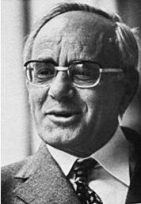
In spite of the magnificent results and perspectives of science, even the modern natural scientist, and the rest of us too who share this mentality, still remain to a large extent really imprisoned in a pre-scientific as well as a pre-philosophical and pre-theological perspective. For even today he and we along with him usually think at the unconscious and unreflexive level that it belongs precisely to the spirit of natural science to see man as a weak and incidental being who is exposed to a nature which is indifferent to him, until finally he is swallowed up again by a "blind" nature. It is only by a kind of schizophrenia that we have anything like a conception of man's dignity and abiding value and of the unique existence of each person. But the notion that man is an accidental and really unintended product of the history of nature, a caprice of nature, contradicts not only metaphysics and Christian faith, but basically it also contradicts natural science itself. If man does exist, and precisely if he is the "product" of nature, if he appears not just at any time at all, but at a definite point in this development, a point at which he himself can even direct this development at least partially by the fact that he now objectifies it and stands over against what has produced him, and transforms the producer itself, then this very nature become conscious of itself in him. But then it is directed towards him because "chance" is not a meaningful term for natural science, and the natural scientist infers from the result at least a movement directed towards it.
If we do not see it this way, then it makes no sense at all to see the history of the cosmos and that of man as a single history. But then human thought will sooner or later fall back into a platonic dualism again, for spirit will then have to feel like a stranger who is on earth by chance, and it will not allow itself for long to be disdained and abused as insignificant and powerless. If spirit is not regarded as the goal of nature itself, and if it is not seen that nature finds itself in spirit in spite of all the physical powerlessness of the individual person, then in the long run man will only be able to have validity as the disparate adversary of nature, and he will form this estimate of himself.
--Karl Rahner, Foundations of Christian Faith (1978), pp. 188-9.
Subscribe to:
Posts (Atom)

