Showing posts with label Platonism. Show all posts
Sunday, May 19, 2013
Theodicy and Determinism: Leibniz's Folly of the "Best Possible World"
The theodicy conundrum is typically set up as a "best possible worlds" dilemma: of all possible worlds that could have been created, why would an all-loving, all-knowing, and all-powerful God create a world in which evil and suffering exist? Why did God create the circumstances that would allow Adam to sin? These questions, the stuff of anti-theist rejoinders, have been the perennial bane of Christ theology for time immemorial.
Read the Article here.
Labels:
Arminianism,
Calvinism,
Determinism,
Election,
Eternity,
Platonism,
Theodicy
Tuesday, March 12, 2013
Rehabilitating Pelagius: The Making of the West's Most Notorious "Heretic"
That Augustine did indeed retain something of his former Manichee views of human nature seems a fair assessment on Pelagius's part. But rather than base his pessimistic views of human nature in the Manichee mythos that the physical universe was not created by God at all, but rather by evil forces, Augustine found in his new Christian faith an explanation that seemed to uphold the doctrine of God as Creator of all things while at the same time exonerating God from being the author of sin. This was, of course, the story of the Fall of Adam in the Book of Genesis, especially as interpreted by Paul in his letter to the Romans (chapter 5).
Read the rest of the article here.
Labels:
Augustine,
Catholic,
Election,
Heresy,
Pelagius,
Platonism,
Sacraments,
Soteriology
Tuesday, June 05, 2007
Gerald Bray on Augustine's Conception of the Spirit as Love

The link between the Trinity and human salvation is clearer in Augustine than in any other ancient writer, and it has indelibly marked the entire Western tradition. The belief that God is love is now such a commonplace that we seldom realize what a new and powerful idea it was to Augustine. Unfortunately though, Augustine formulated his belief in a way which leaves it open to serious question. As he understood it, the essence of God was both spirit and love. Despite serious hesitation, Augustine eventually argued himself into believing that spirit and love were the same thing, with the result that the Holy Spirit must also be the personification of holy love.
The basis for this equation come from a comparison of John 4:24 ('God is spirit') with 1 John 4:16 ('God is love'). Today we would say that the word 'spirit' refers primarily to the nature of God, whereas love is the way in which God functions. To tie the two together as Augustine eventually did is to unite essence and function in a way which distorts the biblical data. This conjunction later became a standard feature of Western theology, which to this day likes to claim that pure being is the same as pure act. During the centuries when the emphasis was ontological, however, love tended to become a remote abstraction. Now that the emphasis has shifted to the functional, the opposite tendency has asserted itself, and love tends to be regarded mainly as a subjective feeling, which is then somehow identified with the very being of God.
In fairness to Augustine, it must be said that he himself never went anything like as far as that. He did not regard 'Spirit' as the personal name of the third person of the Trinity, but only as a designation of the divine nature. As such, the word could and did refer equally to the Father and the Son. On the other hand, Augustine toyed with this question of finding the personal name of the Holy Spirit, but never really came up with a satisfactory answer. At one point he suggested that it might be 'gift' (donum), although that is hardly a personal name in the sense that we would understand it. Later on, he put forward the view that the Spirit's personal name was Holy. this was slightly better than 'gift', but it suffered from the fact that, like Spirit, it was a term which could be applied to the other persons of the Trinity as well.
Augustine's difficulty here is symptomatic of his whole approach, which locates the unity of the Father and the Son in the person of the Holy Spirit. But because the unity of God is expressed at the level of nature, there is an inescapable tendency to think of the Holy Spirit as a personification of the impersonal qualities which constitute the being of God. Admittedly, this tendency is helped to some extent by the impersonal name which is given to the third person, even in the Scriptures, although of course he is also called Comforter (Paraclete). Augustine was aware of this, but neither he nor his successors made much of it when discussing the names of the Trinity in their writings.
--Gerald Bray, The Doctrine of God (Intervarsity, 1993), pp. 171-2.
The basis for this equation come from a comparison of John 4:24 ('God is spirit') with 1 John 4:16 ('God is love'). Today we would say that the word 'spirit' refers primarily to the nature of God, whereas love is the way in which God functions. To tie the two together as Augustine eventually did is to unite essence and function in a way which distorts the biblical data. This conjunction later became a standard feature of Western theology, which to this day likes to claim that pure being is the same as pure act. During the centuries when the emphasis was ontological, however, love tended to become a remote abstraction. Now that the emphasis has shifted to the functional, the opposite tendency has asserted itself, and love tends to be regarded mainly as a subjective feeling, which is then somehow identified with the very being of God.
In fairness to Augustine, it must be said that he himself never went anything like as far as that. He did not regard 'Spirit' as the personal name of the third person of the Trinity, but only as a designation of the divine nature. As such, the word could and did refer equally to the Father and the Son. On the other hand, Augustine toyed with this question of finding the personal name of the Holy Spirit, but never really came up with a satisfactory answer. At one point he suggested that it might be 'gift' (donum), although that is hardly a personal name in the sense that we would understand it. Later on, he put forward the view that the Spirit's personal name was Holy. this was slightly better than 'gift', but it suffered from the fact that, like Spirit, it was a term which could be applied to the other persons of the Trinity as well.
Augustine's difficulty here is symptomatic of his whole approach, which locates the unity of the Father and the Son in the person of the Holy Spirit. But because the unity of God is expressed at the level of nature, there is an inescapable tendency to think of the Holy Spirit as a personification of the impersonal qualities which constitute the being of God. Admittedly, this tendency is helped to some extent by the impersonal name which is given to the third person, even in the Scriptures, although of course he is also called Comforter (Paraclete). Augustine was aware of this, but neither he nor his successors made much of it when discussing the names of the Trinity in their writings.
--Gerald Bray, The Doctrine of God (Intervarsity, 1993), pp. 171-2.
Monday, June 26, 2006
What did Augustine and Arius have in common?

Answer: Both Arius and Augustine defined deity in terms of divine causality, thus understanding causality to be the essential attribute of deity rather than the hypostatic (i.e. personal) feature of the Father's monarchy.
In this confusion of Person, nature and attribute, Arius went on to assert that only the Father was truly God, for the Logos was begotten of the Father. Thus Christ could not be fully divine in that he was "caused by," and in no way the "cause of," the Father. Divine causality and essential deity are inextricably mixed.
In his argument against the later heresy of semi-Arianism, Augustine conceded this point, but went on to employ it in favor of the essential deity of Christ by positing the filioque doctrine. Thus Augustine saw the Son as the "cause," along with the Father, of another divine Person: the Holy Spirit. "For if the Son has of the Father whatever He has, then certainly He has of the Father that the Holy Spirit proceeds also from Him" (De Trinitate 15:26:47). In other words, the Son receives divine causality from the Father and thus is fully divine, for the Holy Spirit proceeds from both.
At this point the inconsistency in Augustine's view of the Trinity becomes apparent, for where does this leave the Holy Spirit? If the Holy Spirit is a fully divine hypostasis then wherein is manifested the attribute of causality?
Food for thought.
Until next time.
P.S. I am indebted to my friend, Dr. Joseph Farrell (+Photius), for these insights.
Augustine's Confusion of Nature, Attribute, and Person in the Godhead

He is called in respect to Himself both God, and great, and good, and just, and anything else of the kind; and just as to Him to be is the same as to be God, or to be great, or as to be good, so it is the same thing to Him to be as to be a person (De Trinitate 7:6:11, from Schaff's The Nicene and Post-Nicene Fathers [1st series], pp. 111-12).
Saturday, April 22, 2006
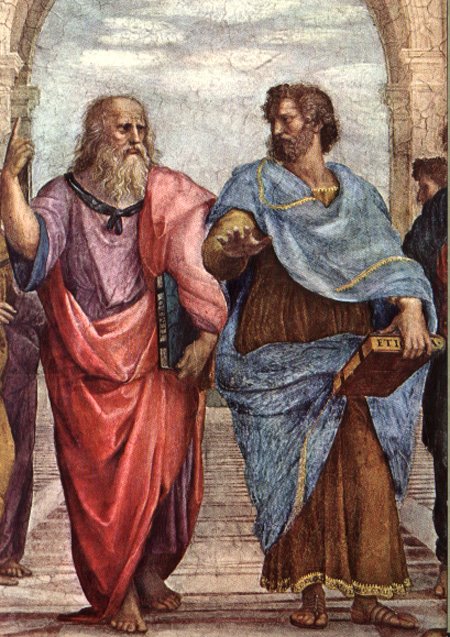
Stuck between Plato and Aristotle

In his insightful book In Defence of the Soul (Oneworld Publications, 1998) Keith Ward of Oxford University states, "What Aquinas was doing was to try to tread a middle way between Plato, who saw the body just as an unnecessary appendage to the soul, and Aristotle, who denied any immaterial, substantive soul at all. Aquinas wanted the human soul both to be capable of independent existence and to be essentially the form of a particular body" (p. 37).
Where Thomas Aquinas agreed with Aristotle was in understanding the soul to be the life-principle or distinctive characteristic of all living things -- the "form (i.e., morphe) of the body" as Aristotle proposed. Hence, even plants and animals have souls, the latter having "sensitive souls" which give their bodies knowledge and sense perception (Ward, p. 36). These souls come into being through natural processes, arising from and informing their physical bodies. But once the body dies, so does the soul.
What Thomas did was to introduce a new idea to Aristotle's basic understanding of the soul, namely that human beings possess a different kind of soul which is created directly by God for each individual person. Like the animals, the human soul is constitutive of the body and performs the same "sensitive" and nutritive functions. But it is different in that it is rational, and thus must come directly from God. "Man," wrote Thomas, "is non-material in respect of his intellectual power because the power of understanding is not the power of an organ" (Summa Theologiae, Q.6 Art. 1; quoted by Ward, p. 36). In other words, rational thought cannot be performed by or arise from something corporeal, which means that the human soul is unique in being substantive and able to exist on its own -- hence immortal. However, an existence without the body would be unnatural since the soul was created for the body (contra Plato), or so Thomas argued.
As I reflect on these things I am struck, first, by how Aristotle's philosophy anticipated the advances made in contemporary thinking on this matter, particularly in what is being presented here in this blog as the "soul as emergent property" theory advanced by Ward and other notable theologians. But the second thing that strikes me is how captivated the Church has been by the thought of Plato. Apparently even Thomas Aquinas, who was almost singlehandedly responsible for weaving Aristotle's thinking permanently into the warp and woof of western theology, could not fully escape Plato's influence.
Until next time.
P.S. - I realize this entry may have raised many more questions about the emergent property theory than it answers. All in due time.
Subscribe to:
Comments (Atom)