...My understanding of our nature is not framed in the dualist terms of an incarnated soul. The Christian hope is, therefore, for me not the hope of survival after death, the persistence post mortem of a spiritual component which possesses, or has been granted, an intrinsic immortality. Rather, the Christian hope is of death and resurrection. My understanding of the soul is that it is the almost infinitely complex, dynamic, information-bearing pattern, carried at any instant by the matter of my animated body and continuously developing throughout all the constituent changes of my bodily make-up during the course of my earthly life. That psychosomatic unity is dissolved at death by the decay of my body, but I believe it is a perfectly coherent hope that the pattern that is me will be remembered by God and its instantiation will be recreated by him when he reconstitutes me in a new environment of his choosing. That will be his eschatological act of resurrection. Thus, death is a real end but not the final end, for only God himself is ultimate. Although there have, of course, been strands of he Christian tradition which have used the language of the survival of an immortal soul, I believe that the tradition which is truer, both to the New Testament insight and to modern understanding, is that which relies on the hope of a resurrection beyond death.
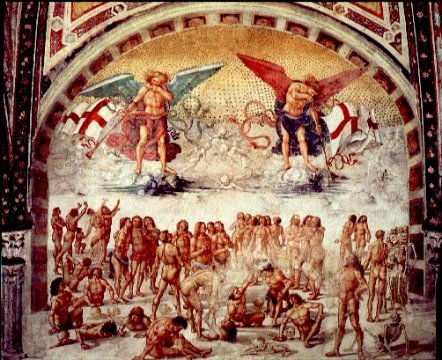
If this psychosomatic understanding is correct, then it is intrinsic to true humanity that we should be embodied. We are not apprentice angels, awaiting to be disencumbered of our fleshly habitation. Our hope is of the resurrection of the body. By that I do not mean the resuscitation of our present structure, the quaint medieval notion of the reassembling of bones and dust. In a very crude and inadequate analogy, the softward running on our present hardware will be transferred to the hardware of the world to come. And where will that eschatological hardware come from? Surely the 'matter' of the world to come must be the transformed matter of this world. God will no more abandon the universe than he will abandon us. Hence the importance to theology of the empty tomb, with its message that the Lord's risen and glorified body is the transmutation of his dead body. The resurrection of Jesus is the beginning within history of a process whose fulfillment lies beyond history, in which the destiny of humanity and the destiny of the universe are together to find their fulfillment in a liberation from decay and futility (cf. Rom. 8:180-5).--John Polkinghorne, Science and Christian Belief, pp. 163-164


