My friend Jeff over at meam-commemorationem recently published a "teaser" from an article critiquing Roman Catholic theologian L-M. Chauvet's postmodern take on Aquinas. Hopefully we can encourage Jeff to publish more entries on this article on his blog. Personally, I have profited greatly from Chauvet's Symbol and Sacrament, and I can already tell from the brief excerpt that the author is going to push a few of my buttons.
The entire article can be found HERE.
Showing posts with label Aquinas. Show all posts
Showing posts with label Aquinas. Show all posts
Friday, January 12, 2007


Saturday, July 01, 2006
Gerald Bray "Gets It": His Discussion of Thomas Aquinas

Aquinas' debts to Augustine and Anselm are obvious, but he was determined to go beyond them and establish a clear distinction between the two divine 'processions', generation and procession (in the classical sense). 'Generation' was defined by Aquinas as an (intellectual) act of conception which produced its like, i.e. the Father reproduced his own likeness in the Son. 'Procession' he defined as an impulse of the divine will, which brings forth something other than a straightforward reproduction of itself. When this impulse is perfect, as it must be within the Godhead, the resulting product will also be fully God. Hence there is a real difference between the Son and the Holy Spirit, both of whom are fully God, although once again the Spirit fits only somewhat uncomfortably into what is basically an Augustinian model of the Trinity.
Not content to stop there, Aquinas used the terms 'paternity', 'filiation' and 'procession' to describe the divine relations. He distinguished them from the essence of God by saying that the former are relative, while the latter is absolute. His abstractions differ from those of the Cappadocians, for whom unbegottenness, begottenness and procession were the absolute distinctions of the hypostases. But like them, he has succumbed to a tendency towards philosophical abstraction which is very different from the spirit of the New Testament. The full effect can be seen in Thomas' definition of the word 'person'. As far as he was concerned, person was an aspect of a nature which signified what was distinct in that nature. Because distinction in God is only by relations of origin, a divine person is defined by Aquinas as a subsistent relation in the being of God. In other words, 'person' and 'relation' are synonymous, which means that one might easily dispose of the unphilosophical term 'person' and speak only of (Aristotelian) relations in God.
The trinitarianism of Anselm and Aquinas can rightly be criticized for being too philosophical, too abstract, and even reactionary, in the sense that it is dependent on the primacy of nature over person -- almost inevitable in any philosophical theology, but directly counter to the spirit of Chalcedonian christology. Unfortunately, christology and trinitarian theology tended to go their separate ways during the high Middle Ages, and they are still not always closely linked even today.
--Gerald Bray, The Doctrine of God (IVP, 1993), pp. 182-3
Saturday, April 22, 2006
Stuck between Plato and Aristotle
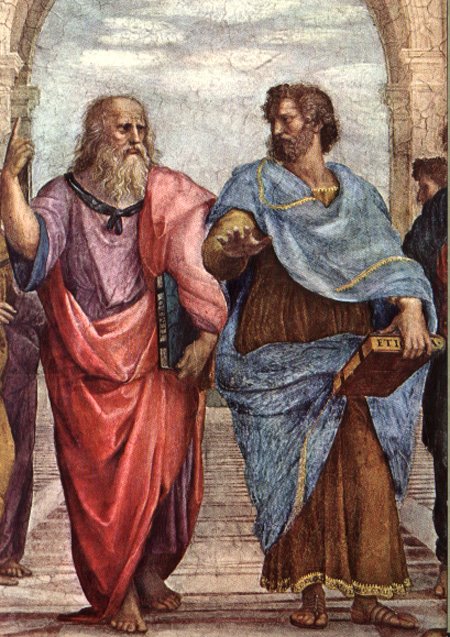
In his insightful book In Defence of the Soul (Oneworld Publications, 1998) Keith Ward of Oxford University states, "What Aquinas was doing was to try to tread a middle way between Plato, who saw the body just as an unnecessary appendage to the soul, and Aristotle, who denied any immaterial, substantive soul at all. Aquinas wanted the human soul both to be capable of independent existence and to be essentially the form of a particular body" (p. 37).
Where Thomas Aquinas agreed with Aristotle was in understanding the soul to be the life-principle or distinctive characteristic of all living things -- the "form (i.e., morphe) of the body" as Aristotle proposed. Hence, even plants and animals have souls, the latter having "sensitive souls" which give their bodies knowledge and sense perception (Ward, p. 36). These souls come into being through natural processes, arising from and informing their physical bodies. But once the body dies, so does the soul.
What Thomas did was to introduce a new idea to Aristotle's basic understanding of the soul, namely that human beings possess a different kind of soul which is created directly by God for each individual person. Like the animals, the human soul is constitutive of the body and performs the same "sensitive" and nutritive functions. But it is different in that it is rational, and thus must come directly from God. "Man," wrote Thomas, "is non-material in respect of his intellectual power because the power of understanding is not the power of an organ" (Summa Theologiae, Q.6 Art. 1; quoted by Ward, p. 36). In other words, rational thought cannot be performed by or arise from something corporeal, which means that the human soul is unique in being substantive and able to exist on its own -- hence immortal. However, an existence without the body would be unnatural since the soul was created for the body (contra Plato), or so Thomas argued.
As I reflect on these things I am struck, first, by how Aristotle's philosophy anticipated the advances made in contemporary thinking on this matter, particularly in what is being presented here in this blog as the "soul as emergent property" theory advanced by Ward and other notable theologians. But the second thing that strikes me is how captivated the Church has been by the thought of Plato. Apparently even Thomas Aquinas, who was almost singlehandedly responsible for weaving Aristotle's thinking permanently into the warp and woof of western theology, could not fully escape Plato's influence.
Until next time.
P.S. - I realize this entry may have raised many more questions about the emergent property theory than it answers. All in due time.
Subscribe to:
Posts (Atom)

