In typical fashion, I am lagging behind in giving my impressions on the BIG news of last week; big news for the Anglican world at least. But I like to let the dust settle on such things before I add my two cents.
First: The Camp Allen Meeting. For me, this was the most encouraging news I've heard in a long time, and I congratulate my bishop, +Don Wimberly, for his leadership. Simply put, the future of the Anglican Communion, not to mention any semblance of American Episcopalian membership in it, depends on a much broader coalition of dioceses and bishops than those that make up the Network. It is not that I wish to see the Network sidelined. They have an important voice that needs to be heard. But their voice is only one of many within the "Windsor compliant" camp. It is far better that they take a place at the table, than to presume that they can continue to go it alone.
Second: The Kigali Communique. That the meeting of the Global South bishops in Kigali occurred in the same week as, though quite independently of, the Camp Allen meeting of Windsor bishops was most unfortunate. This gave the false impression to many that they were coordinated events, an impression that gave way to early cries of treachery by some conservative commentators when it appeared that the letter from the Camp Allen meeting failed to acknowledge, or worse, amounted to a veiled dismissal of, the Kigali Communique (released just hours before the Camp Allen letter). Frankly, I'm not sure what to make of the Communique yet. It is surprisingly reserved and thoughtful, in contrast to what I expected. I am grateful that the Communique articulates the Global South's willingness to work towards solutions that seek to preserve the Anglican Communion, rather than constituting yet another subtle threat to unravel it.
What does concern me, however, is that the Communique has been twinned with another statement, "The Road to Lambeth", commissioned by the Primates of the Council of Anglican Provinces in Africa (CAPA) in February 2006, and "received with gratitude" by the CAPA bishops on September 19, 2006. Admittedly, it was merely "commended for study and response" to the churches of the provinces in Africa. Nevertheless, its much stronger resolve to force the pressing issues or ditch the Communion altogether is what I've come to expect from Akinola and his camp. But there is another reason to be concerned. For all of the talk in "The Road to Lambeth" about how the Global South, and particularly the African provinces, have come of age, and no longer need the West to do their thinking for them, one of its main architects (and I suspect its primary author) is an AMERICAN -- Dr. Stephn Noll (currently serving as Vice Chancellor of Uganda Christian University in Mukono, Uganda). Dr. Noll's decidedly skeptical stance on the necessity or desirability of preserving a Canterbury-centered Communion is well-known.
Perhaps it would have been wiser for Dr. Noll to have recused himself from taking a leading role in the drafting of this statement. The revisionists have said all along that this whole affair had the smell of being orchestrated by American arch-conservatives who really have no desire to preserve a Canterbury-centered communion. Noll is just such an American. If CAPA wanted to avoid the appearance of taking their cue from American arch-conservatives, then the wiser course of action would have been to keep ALL Americans, and particularly those with strong anti-Canterbury views like Noll, away from the drafting of statements that presume to represent their voice.
Just an opinion.
Saturday, September 30, 2006


Thursday, September 21, 2006
C.S. Lewis: The Faithful Calormene

Lo! in a narrow place between two rocks there came to meet me a great Lion. The speed of him was like the ostrich, and his size was an elephant's; his hair was like pure gold and the brightness of his eyes like gold that is liquid in the furnace. He was more terrible than the Flaming Mountain of Lagour, and in beauty he surpassed all that is in the world even as the rose in bloom surpasses the dust of the desert.
Then I fell at his feet and thought, "Surely this is the hour of death, for the Lion (who is worthy of all honour) will know that I have served Tash all my days and not him." Nevertheless, it is better to see the Lion and die than to be Tisroc of the world and live and not to have seen him.
But the Glorious One bent down his golden head and touched my forehead with his tongue and said, "Son, thou art welcome."
But I said, "Alas, Lord, I am no son of thine but the servant of Tash."
He answered, "Child, all the service thou hast done to Tash, I account as service done to me."
Then by reasons of my great desire for wisdom and understanding, I overcame my fear and questioned the Glorious One and said, "Lord, it is then true, as the Ape said, that thou and Tash are one?"
The Lion growled so that the earth shook (but his wrath was not against me) and said, "It is false. Not because he and I are one, but because we are opposites, I take to me the services which thou hast done to him. For I and he are of such different kinds that no service which is vile can be done to me, and none which is not vile can be done to him. Therefore if any man swear by Tash and keep his oath for the oath's sake, it is by me that he has truly sworn, though he knew me not, and it is I who reward him. And if any man do a cruelty in my name, then, though he says the name Aslan, it is Tash whom he serves and by Tash his deed is accepted. Dost thou understand, Child?"
I said, "Lord, thou knowest how much I understand." But I said also (for the truth constrained me), "Yet I have been seeking Tash all my days."
"Beloved," said the Glorious One, "unless thy desire had been for me thou wouldst not have sought so long and so truly. For all find what they truly seek."
Then he breathed upon me and took away the trembling from my limbs and caused me to stand upon my feet. And after that, he said not much, but that we should meet again, and I must go further up and further in. Then he turned him about in a storm and flurry of gold and was gone suddenly.
--The Chronicles of Narnia: The Last Battle, Chapter 15: "Further Up and Further In"
Tuesday, September 19, 2006
Henri de Lubac: The Obligation to Enter the Church

...For humanity taken as a whole, there can be no salvation outside the Church, that this is an absolute necessity, and a necessary means to which there can be no exception.
In this way the problem of the "salvation of unbelievers" receives a solution on the widest scale and at the same time no opening is left for compromising laxity. There is no encouragement to indifference. We see now how the Church can, in the words of a theologian, "be merciful to paganism without diminishing her proper character of being the only vehicle of salvation for souls"; and if it is thought that in spite of all these considerations the formula "outside the Church, no salvation" has still an ugly sound, there is no reason why it should not be put in a positive form and read, appealing to all men of good will, not "outside the Church you are damned", but "it is by the Church and by the Church alone that you will be saved". For it is through the Church that salvation will come, that it is already coming to mankind.
Of course the method of this salvation will differ according to whether the unbeliever has or has not encountered the Church. In the second case the only condition on which his salvation is possible is that he should be already a Catholic as it were by anticipation, since the Church is the "natural place" to which a soul amenable to the suggestion of grace spontaneously tends. The "less" is then sufficient -- to employ the expression for the last time -- not in itself, of it own worth, but insofar as it aspires to the "more", insofar as it is ready to be lost in this "more" directly the exterior obstacles which hide the "more" from it are removed.
--Catholicism: Christ and the Common Destiny of Man, pp. 235-37.
Saturday, September 16, 2006
A Generous Orthodoxy - But Not Necessarily of the McLaren Kind
Recently I published excerpts from two of the most prominent Roman Catholic theologians of the twentieth century: Henri de Lubac and Karl Rahner. Together their theological influence on the 2nd Vatican Council and post-conciliar theology has been immense. Consequently, the shadows of both theologians loom large over the monumental Catechism of the Catholic Church (1994). For example, De Lubac's positive re-formulation of St. Cyprian's dictum "Outside the Church, no salvation" (cf. Catechism, 846-848) has not only had profound implications for Rome's ecumenical endeavors, but upon her missiological ones as well (cf. 856). One can readily see Rahner's "anonymous Christian" alongside of De Lubac's optimistic take on humanity's common destiny. Rahner's influence also underlies the Cathechism's discussion of original sin, particularly in embracing Rahner's understanding of the analogical sense of "sin" in the classic statement of the doctrine (cf. 404, 405).
There is little question that, in retrospect, theologians of the 21st century will one day look back to the late 20th century as the Roman Church's most shining moment thus far. Not that there weren't problems or mistakes made along the way, but somehow, some way, the Roman Church of the 20th century was able to create a context for theological inquiry that I think can rightly be described as "a generous orthodoxy" (a phrase that Brian McLaren and the emergent church unfortunately threaten to turn into a cliche).
My own hypothesis is that this is the result of Rome's tenacious adherence to creedal and conciliar commitments (despite the filioque) combined with an openess to intellectual inquiry that permits her theologians to enter into constructive dialogue with modern advances in the sciences and other disciplines. In this way orthodox creedal and conciliar commitments serve as boundary markers establishing the wide perimeter within which the catholic theologian is free to explore and incorporate new discoveries of the world around us, which in turn helps in large part to illuminate and reinvigorate an ancient faith.
Ironically, once upon a time this was more the rule in Anglicanism than it was for Rome. In fact, I would go so far as to say that this was once a strength and characteristic peculiar and unique to Anglicanism. One need only compare Anglicanism's "generous orthodoxy" of the late 19th and early 20th centuries with the calicified post-Tridentine Roman Church of the same period. Indeed, my hunch (though I haven't done enough research yet to prove it) is that the reason behind Rome's dramatic and largely successful de-calcification of late was that it "stole" this particular page right out of the Anglican play-book, at the same time that, tragically, Anglicanism began to move, if not to ignore outright, the ancient boundary stones that once kept her from going astray.
There is little question that, in retrospect, theologians of the 21st century will one day look back to the late 20th century as the Roman Church's most shining moment thus far. Not that there weren't problems or mistakes made along the way, but somehow, some way, the Roman Church of the 20th century was able to create a context for theological inquiry that I think can rightly be described as "a generous orthodoxy" (a phrase that Brian McLaren and the emergent church unfortunately threaten to turn into a cliche).
My own hypothesis is that this is the result of Rome's tenacious adherence to creedal and conciliar commitments (despite the filioque) combined with an openess to intellectual inquiry that permits her theologians to enter into constructive dialogue with modern advances in the sciences and other disciplines. In this way orthodox creedal and conciliar commitments serve as boundary markers establishing the wide perimeter within which the catholic theologian is free to explore and incorporate new discoveries of the world around us, which in turn helps in large part to illuminate and reinvigorate an ancient faith.
Ironically, once upon a time this was more the rule in Anglicanism than it was for Rome. In fact, I would go so far as to say that this was once a strength and characteristic peculiar and unique to Anglicanism. One need only compare Anglicanism's "generous orthodoxy" of the late 19th and early 20th centuries with the calicified post-Tridentine Roman Church of the same period. Indeed, my hunch (though I haven't done enough research yet to prove it) is that the reason behind Rome's dramatic and largely successful de-calcification of late was that it "stole" this particular page right out of the Anglican play-book, at the same time that, tragically, Anglicanism began to move, if not to ignore outright, the ancient boundary stones that once kept her from going astray.
Karl Rahner on Original Sin

"Original sin" in the Christian sense in no way implies that the original, personal act of freedom of the first person or persons is transmitted to us as our moral quality. In "original sin" the sin of Adam is not imputed to us. Personal guilt from an original act of freedom cannot be transmitted, for it is the existentiell [sic] "no" of personal transcendence towards God or against him. And by its very nature this cannot be transmitted, just as the formal freedom of a subject cannot be transmitted. This freedom is precisely the point where a person is unique and no one can take his place, where he cannot by analyzed away, as it were, either forwards or backwards or into his environment, and in this way escape responsibility for himself. For Catholic theology, therefore, "original sin" in no way means that the moral quality of the actions of the first person or persons is transmitted to us, whether this be through a juridical imputation by God or through some kind of biological heredity, however conceived.
In this connection it is obvious that when the word "sin" is used for the personal, evil decision of a subject, and when on the other hand it is applied to a sinful situation which derives from the decision of another, it is being used only in an analogous sense, and not in a univocal sense...
--Karl Rahner, Foundations of Christian Faith, p. 111
Friday, September 15, 2006
De Lubac on "The Role of Unbelievers"

...For since a necessary function in the history of our salvation was fulfilled by so great a mass of "unbelievers" -- not indeed in that they were in formal error or in a state of degradation, but in that there is to be found in their beliefs and consciences a certain groping after the truth, its painful preparation or its partial anticipation, discoveries of the natural reason and tentative solutions - so these unbelievers have an inevitable place in our humanity, a humanity such as the fall and the promise of a Redeemer have made it.
There is no comparison between their role and that of the scaffolding which, necessary as it is in the construction of a building, is discarded once the building is complete without further thought of what will become of it. For if the heavenly Jerusalem is built of living stones, it is also living beings that go to make its scaffolding. In other words, humanity is made up of persons who have all the same one eternal destiny, in whatever category or century their birth has placed them; their relationships cannot be envisaged, then, as just external ones, as if some existed only to prepare suitable conditions for the development of others, as in Renan's paradox of the coming of a superman. In spite of great differences of understanding and function, all members of the human race enjoy the same essential equality before God.
As "unbelievers" are, in the design of Providence, indispensable for building the Body of Christ, they must in their own way profit from their vital connection with this same Body. By an extension of the dogma of the communion of saints, it seems right to think that though they themselves are not in the normal way of salvation, they will be able nevertheless to obtain salvation by virtue of those mysterious bonds which unite them to the faithful. In short, they can be saved because they are an integral part of the humanity which is to be saved.
--Henri de Lubac, Catholicism: Christ and the Common Destiny of Man, pp. 232-233
Thursday, September 07, 2006
SPREAD Petition: I saw this coming...
Okay, so I'm a few weeks behind the news, but my readers will have to admit that I saw this coming. Click on this LINK to view the SPREAD petition.
I'm a little disappointed, but not at all surprised, that the call for the break-up of the Communion would come from a leader within a group whose status in the Communion is tenuous at best. I have to be careful here, because I have good friends in the AMiA, and connections with other Common Cause Partners. But herein lies a textbook example of fomenting separation and division for the sake of unity (a contradiction, I know, so why can't they see this?) However, as is always the case, it will not be unity that is achieved, but rather an arrogated identity. Case in point: notice how the author defines who is, and who is not, a true "Anglican." What's wrong with this picture?
I'm a little disappointed, but not at all surprised, that the call for the break-up of the Communion would come from a leader within a group whose status in the Communion is tenuous at best. I have to be careful here, because I have good friends in the AMiA, and connections with other Common Cause Partners. But herein lies a textbook example of fomenting separation and division for the sake of unity (a contradiction, I know, so why can't they see this?) However, as is always the case, it will not be unity that is achieved, but rather an arrogated identity. Case in point: notice how the author defines who is, and who is not, a true "Anglican." What's wrong with this picture?
Monday, September 04, 2006
Sunday, September 03, 2006
Keith Ward: Beyond Boundaries

The following article comes from The Tablet. Keith Ward is one of my favorite contemporary theologians. This is worth a read.
Beyond Boundaries - The Infinite Creator
Pope Benedict and his former doctoral students meet this weekend to discuss creation and evolution. Despite their apparent differences, the idea of the evolution of human life and its intelligent design by God are not in conflict, says one leading philosopher of religion.
I was surprised to discover a survey of over 1,000 students last month by Opinion Panel Research, an independent research group for recording student opinions on a wide range of topics, which purported to show that over 30 per cent of UK students believed in "creationism or intelligent design, rather than evolution". I was not quite so surprised when I found that "creationism" was defined as the view that God created us within the last 10,000 years, and "intelligent design" as the view that some features of living things are due to a supernatural being such as God. The trouble with this is the vagueness of the definition of "intelligent design". For every orthodox Christian, it is necessarily true that some features of living things are due to God. In fact all features of living things are due to God, and the cosmos is indeed designed with supreme wisdom and intelligence. So any student might say that they believe in intelligent design, but that would not compete with belief in the evolution of life.
God creates adult human beings as organisms that have developed from a single cell over a period of time. It is not in principle different to say that God created human beings on earth as a species that developed from single cell organisms by a process of development over four thousand million years. The evolution of human life, and its intelligent design by God, are not in conflict.
I guess that some students were rightly puzzled by the question. This is not surprising, because there is a school of thought in America that propagates what it calls "intelligent design". These theorists, like William Dembski and Michael Behe, do not deny evolution. They propose that some specific and identifiable phenomena, like the bacterial flagellum or the blood-clotting cascade, are "irreducibly complex", and cannot be accounted for by the Darwinian mechanism of natural selection alone. They require specific intelligent planning, presumably by something very like God.
The vast majority of biologists regard this as an extremely weak hypothesis. Most informed Catholic theologians agree with the American Catholic philosopher, John Haught, that it is also a very questionable view of how God interacts with the world. It suggests that God has to interfere with physical processes every now and then in identifiable ways. This theory was christened the "God of the gaps" hypothesis by the British mathematician Charles Coulson. It seems at odds with the Christian view that God is constantly sustaining and directing all creatures.
So it is important to distinguish the American "intelligent design" school from the general Christian belief that the universe, and the evolutionary process as a whole, are indeed designed by a supreme intelligence. If the students surveyed were indeed confused by the question, then only about 12 per cent of students questioned in the survey were "young Earth" believers - that is, they thought the universe to be less than 10,000 years old. This is still very sad, since it is the virtually unanimous testimony of astronomers and cosmologists that the cosmos is 14 billion years old. It demonstrates a huge conflict between the best modern science and the Christian (or Muslim) beliefs of some students. It means that such students will regard modern science as the enemy of faith.
Modern science originated in a context of Christian belief that God had created the cosmos through reason, through the Logos, and that the human mind could discern the glory of God in the works of creation. It is regrettable in the extreme that some Christians have now abandoned this belief.
Neither the Pope nor the Archbishop of Canterbury nor the overwhelming majority of Christian theologians are creationists, so what accounts for this strange state of affairs? I think two main factors are at work. First there is a loss of a sense of the importance of metaphor and poetic language in religion. Nobody believes that the Earth is a flat disc floating on a great sea of chaos, or that the stars are lamps hung on the dome of the sky, above which is another great sea. Yet that is what the Book of Genesis literally says. So all agree that we cannot read the Genesis creation account (or two accounts) literally.
Once you have made that step, the obvious thing to say is that here is a piece of inspired poetry, depicting the dependence of all things on the creative wisdom of God. There is a literal truth expressed in the text - the dependence of all things on God - but the text expresses it in a poetic way that is both more emotionally affective and more evocative of associated ideas. The problem is that some people think poetry is not important, or cannot express things which go beyond what can be literally described. This is the death of religious imagination, and it is sad to see the profound symbols and metaphors of religion reduced to literal descriptions of purely physical facts.
Second, there is a failure to see the amazing cosmic vision that modern cosmology provides for Christian faith. That God should, over thousands of millions of years, by laws of incredible beauty and simplicity, bring out of the basic matter of the early universe all the complexity of galaxies, planets, living beings and intelligent moral awareness, is truly wonderful. As the letters to the Ephesians and Colossians depict it, Christ is the eternal wisdom of God through whom this unimaginably vast emergent cosmos was formed and in whom it develops, working towards what the writer calls the "final mystery" of the divine will set forth in Christ, the unity of everything in the cosmos (the writer says, "everything in heaven and earth", and we might say all the stars and galaxies), in Christ (Ephesians 1, 9).
This is a religious vision of the utmost grandeur. Christ is Lord of the galaxies, and foreshadows on this planet the final goal of all creation, to be united in God. The cosmos is moving towards a great goal, it groans as in childbirth waiting for the revealing of the children of God (Romans 8:19). For a Christian, evolution is not just intelligently designed; it manifests a divinely intended purpose, that the material universe itself should become a sharer in the life of God, as it grows towards its fullness in Christ.
What a grandeur of vision those who cannot accept evolution are bound to miss. How much smaller and more restricted is a God who has only one little planet to worry about, and that not for very long. How much greater it is to worship the creator of innumerable worlds of beauty and wisdom, and to be grateful that this infinite creator has been pleased to be known in human form on this planet, at this point in cosmic history.The argument about creationism in our schools is not really about science, because the creationist theory is based not on scientific study, but on a particular literalistic interpretation of Scripture. There are important questions at issue about the proper understanding of science. Some scientists say science gives an adequate explanation of everything, that evolutionary science shows human life to be a random accident in a purposeless universe, and that science excludes the possibility of divine action in the world or of miracles. It is important to see that these are not scientific statements. They are philosophical remarks about what science is. No believer in God could accept them. So Christians would wish to say that God, who is most truly real, is beyond the range of scientific explanation. Evolutionary science does not rule out a belief that the evolution of human beings is purposive and eternally planned by God. God can act in the world, but God's actions cannot in principle be explained by any scientific laws.
There are arguments here, but they are about philosophy, and classes in philosophy are the right place to discuss them. Yet as part of that discussion it is important to see that Christianity is not a sort of physical science, which rejects what the best physical scientists say. It is about the existence of God as the supreme spiritual reality, and about how God relates to the human world through the person of Jesus and the Church.
Creationism seems to be gaining strength because people are failing to see or to convey the deep truth and distinctive nature of religious language, and failing to see the truly exciting cosmic vision that Christianity has to proclaim. These are the things a properly Christian education should seek to convey; if they are seen, then the debate about creationism might simply fade away.
Friday, September 01, 2006
Pope to debate evolution with students
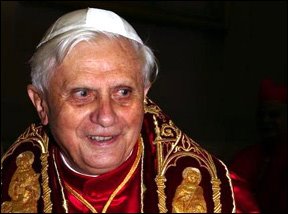
I'm really looking forward to more news on this! Though I'm a little irked that the media continues to portray Intelligent Design theory as inimical to evolutionary processes. I would think that modern catholic thought on the subject (if not Benedict himself) may be seeking a way to merge the two ideas, an attempt which should be applauded.
The following article comes from The Australian. Biretta tip to Kendall and crew over at titusonenine.
By Tom Heneghan in Paris
August 30, 2006
POPE Benedict will gather some of his former theology students on Friday for a private weekend debate on evolution and religion, an issue conservative Christians have turned into a political cause in the United States.
Benedict, who taught theology at four German universities before rising in the Catholic Church hierarchy, has pondered weighty ideas with his former Ph.D students at annual meetings since the late 1970s without any media fuss.
But his election as pope last year and controversies over teaching evolution in the United States have aroused lively interest in this year's reunion on September 1-3 at the papal summer residence of Castel Gondolfo outside Rome.
Religion and science blogs are buzzing about whether it means the Vatican will take a more critical view of evolution and possibly embrace "Intelligent Design," which claims to have scientific proof that human life could not have simply evolved.
But Father Stephan Horn, a German theologian organising the pope's meeting with 39 former students, said that reflected a misunderstanding of how the so-called "student circle" works and what the Catholic Church teaches about evolution. "We've never drawn any conclusions in our student circle," he said. "This is an open exchange of ideas that does not aim for a conclusion.
"It has nothing to do with creationism," he added, referring to a fundamentalist Protestant view that God created the world in six days as described in the Book of Genesis. "Catholic theology does not endorse creationist views."
Tuesday, August 29, 2006
Beginning of Fall Semester
It is the beginning of a new semester and a new academic year -- a very busy time for Academic Deans. And so my blog has been neglected of late. However, rest assured, I should have a new posting up by the weekend. Til then.
Thursday, August 24, 2006
Russian Church offers support to American bishops
This is incredible.
http://www.interfax-religion.com/?act=news&div=1884
P.S. Biretta tip to Kendall over at T19.
http://www.interfax-religion.com/?act=news&div=1884
P.S. Biretta tip to Kendall over at T19.
Saturday, August 19, 2006
College Football "Sweet 16" Meme
He doesn't know it yet, and he certainly didn't intend to do it, but my friend Doug just started a College Football "Sweet 16" meme. Cruise on over to see Doug's Sweet 16 and compare it to mine (yeah right, as if I know what I'm doing!). Here are the AP's Top 25.
Here's my list of how I think the season will finish:
1. Ohio State
2. LSU
3. West Virginia
4. USC
5. Texas
6. Auburn
7. Florida
8. California
9. Florida State
10. Michigan
11. Notre Dame
12. Oklahoma
13. Louisville
14. Penn State
15. Iowa
16. Georgia
P.S. - I tag any blogging college football fan who reads this.
Here's my list of how I think the season will finish:
1. Ohio State
2. LSU
3. West Virginia
4. USC
5. Texas
6. Auburn
7. Florida
8. California
9. Florida State
10. Michigan
11. Notre Dame
12. Oklahoma
13. Louisville
14. Penn State
15. Iowa
16. Georgia
P.S. - I tag any blogging college football fan who reads this.
Perilously close to Donatism
Kendall Harmon recently posted Bp. Lispcomb's comments over at T19 in view of the upcoming Bishop's Summit at Lambeth next month. Lispcomb makes the following statement about those dioceses requesting alternative primatial oversight (APO):
"I’m not sure what they’re asking for. By our constitution, we have a direct linkage to Canterbury anyway. The reason you all are Anglicans is because your bishop is in communion with the See of Canterbury already..."
Lispcomb makes a great point. Why do they need APO? Indeed, I can understand the requests of the dioceses of Ft. Worth and San Joachin, neither of which ordain women to the priesthood or to the episcopate. A good case could be made that these dioceses at least have theological justification for APO. But what theological justification do Pittsburgh, South Carolina and others (i.e. dioceses that DO ordain women) have for requesting APO, apart from the fact that they just don't happen to like Bp. Jefferts-Schori?
It seems to me that, apart from Ft. Worth and San Joachin, dioceses requesting APO are perilously close to the ancient heresy of Donatism at this point. This could very well turn out to be a fatal flaw in their overall strategy, especially if they have put all or most of their eggs in the APO basket. In the event that the ABC turns down their theologically-dubious request next month, we could witness the straw that breaks the camel-supporting-the-patience-of-the-Global-South's back. So sad.
Lord have mercy.
"I’m not sure what they’re asking for. By our constitution, we have a direct linkage to Canterbury anyway. The reason you all are Anglicans is because your bishop is in communion with the See of Canterbury already..."
Lispcomb makes a great point. Why do they need APO? Indeed, I can understand the requests of the dioceses of Ft. Worth and San Joachin, neither of which ordain women to the priesthood or to the episcopate. A good case could be made that these dioceses at least have theological justification for APO. But what theological justification do Pittsburgh, South Carolina and others (i.e. dioceses that DO ordain women) have for requesting APO, apart from the fact that they just don't happen to like Bp. Jefferts-Schori?
It seems to me that, apart from Ft. Worth and San Joachin, dioceses requesting APO are perilously close to the ancient heresy of Donatism at this point. This could very well turn out to be a fatal flaw in their overall strategy, especially if they have put all or most of their eggs in the APO basket. In the event that the ABC turns down their theologically-dubious request next month, we could witness the straw that breaks the camel-supporting-the-patience-of-the-Global-South's back. So sad.
Lord have mercy.
Tuesday, August 15, 2006
Turning Muslim in Texas
I'm having difficulty embedding this video to my blog. So here's the link:
http://www.youtube.com/watch?v=2CjJVIiHC20
It's a shocking video. But I think it's indicative of the failure of American evangelical culture, especially in the recurring comment made by converts that they found in Islam everything they wanted in the Church.
http://www.youtube.com/watch?v=2CjJVIiHC20
It's a shocking video. But I think it's indicative of the failure of American evangelical culture, especially in the recurring comment made by converts that they found in Islam everything they wanted in the Church.
Thursday, August 10, 2006
Barth on a Budget
Ben Meyers over at the Faith and Theology blog posted two great reading lists for anyone looking to get better acquainted with the late, great Karl Barth. Check it out HERE.
Tuesday, August 08, 2006
How Dix distorted Cranmer's position

Until the mid-20th century, when Dom Gregory Dix proposed otherwise, the most common explanation for the verbal differences between the eucharistic rites of 1549 and 1552 involved the political pressures exerted on liturgical reform, and on Cranmer himself, in the last half of the reign of Edward VI. The coup de tat that brought down the Somerset government also replaced its cautious and moderate religious reform (in keeping with Cranmer’s own views) with the more radical and thoroughgoing agenda of the Northumberland regime. Significantly this change ushered in a favorable climate for the political ascendancy of the Züricher party -– consisting of reformers of Zwinglian sympathies such as John Hooper, Bp. of Gloucester.
Of the two rites, 1549 was seen as more in keeping with Cranmer’s mind in its articulation of Christ’s presence in the Eucharist. This did not mean, however, that the 1552 rite constituted a “different mind” or a fully Zwinglian alternative; but rather one that, for political reasons, had been crafted to be more Zwinglian-friendly. This view remained the standard reading of Cranmer's two liturgical projects up to the early 20th century, even among prominent Anglo-Catholic liturgical scholars such as the godly Bishop of Truro, Walter Howard Frere.
The beauty of this explanation lies in how well it explains three seemingly conflicting elements in the story of the liturgical reform that had produced the two Books of Common Prayer. The first was Cranmer’s insistence throughout the latter years of his life that he had only ever held two views of eucharistic presence: transubstantiation, and what he came to refer to as the “true and catholic doctrine” of the Supper, a view that he had come to embrace by ca. 1546. The second element consisted of the verbal changes themselves: namely, the softening, and in some cases the removal, of the 1549 rite’s overt instrumental/objectivist language to produce a rite significantly more palatable to the Zürichers. The third element was the fact that, even after the changes and often in spite of them, the rite could still continue to support a catholic reading, a fact celebrated by E.B. Pusey in Tract 80 (1836). It’s in this third element – this liturgical “sleight of hand” – where Cranmer’s true genius shines through.
A striking example of this sleight of hand can be seen in the removal of the phrase “in these holy mysteries” from the Prayer of Humble Access in 1552:
"Grant us therefore, gracious Lord, so to eat the flesh of thy dear Son Jesus Christ, and to drink his blood in these holy mysteries…"
To eat the body and drink the blood of Christ “in these holy mysteries” (i.e. consuming the elements) assumes an instrumental and objectivist understanding of Christ’s presence in the Supper; an understanding utterly abhorrent to Zwinglians of the period, as evidenced by Bp. Hooper’s refusal to use the new Prayer Book for this and similar reasons. Yet, while the removal of the phrase went far to placate those of Zwinglian sympathies, to suggest that this change irreparably altered the theology of the prayer would be a huge overstatement. The Prayer of Humble Access, even without its fuller catholic expression, was still capable of supporting its natural catholic meaning.
But such blunting of the instrumental and objective language would inevitably cause some of his contemporaries to wonder aloud whether Cranmer had shifted to more a continental Reformed view. This Cranmer adamantly denied to his dying day; and no serious scholar, not even Dix, ever questioned this testimony until quite recent times.
Where Dix departed from conventional wisdom was not in contradicting Cranmer’s testimony on this matter, but rather in proposing that the 1552 rite, not the 1549, expressed Cranmer’s “true mind” during his Protestant period, and, moreover, that this true mind was decidedly “Zwinglian.” For Dix, the changes made to the 1552 edition (rather than the edition itself) were evidence not only of Zwinglian influences on liturgical reform, but also of overt Zwinglianism in Cranmer himself. And since Dix believed that Cranmer was a Zwinglian even before he wrote the 1549 rite, then logically the 1549 rite must be Zwinglian too!
The problem that Dix would encounter, and one he would never be able to explain adequately, was the language of the 1549 rite. If Cranmer was a convinced Zwinglian as early as, say, 1548, then how could he have been so careless (deliberate?) in the use of such instrumental language of presence? The best that Dix could do was to explain away the language of 1549 as “ambiguous,” the sense of which would be “fully perfected” in the rite of 1552. In the final analysis, the 1549 rite was "guilty," not on account of its own deficiencies, but merely by association.
Thus, for Dix, the interpretive key to reading anything that Cranmer ever wrote on the Eucharist (even the 1549 rite) was to read backwards from 1552 through Zwinglian spectacles. Once this modus operandi is appreciated one can begin to see more clearly the motive and agenda behind it: nothing less than the full discrediting of the Cranmerian Prayer Book tradition.
Until next time.
Saturday, August 05, 2006
Wednesday, August 02, 2006
Three Reasons to Discard Your Copy of Dix's Shape of the Liturgy
This entry comes from the comment section of my last entry. I thought I'd open this up for more discussion, if anyone is game.
Three reasons why you should discard your copy of Dom Gregory Dix's The Shape of the Liturgy, if you haven't already:
1. Dix's whole 4-fold shape of the liturgy thesis is contrived on his own speculation, with absolutely no historical verification or support (read none). As a result, those contemporary rites that are based on Dix's thesis are built around an artificial construct.
2. Anything of actual historical significance in the book can be obtained from better and more up to date works. So STL is utterly obsolete as an authority in liturgical studies, despite the opinions of a number of antiquarians and liturgical wannabes who still treat the book as if it were the most important liturgical resource ever written.
3. Dix never understood Cranmer's theology, but presented himself authoritatively as if he did. The resulting damage done to Cranmer studies and studies on the Anglican liturgy will take generations to undo (if ever).
Those are three reasons off the top of my head.
Three reasons why you should discard your copy of Dom Gregory Dix's The Shape of the Liturgy, if you haven't already:
1. Dix's whole 4-fold shape of the liturgy thesis is contrived on his own speculation, with absolutely no historical verification or support (read none). As a result, those contemporary rites that are based on Dix's thesis are built around an artificial construct.
2. Anything of actual historical significance in the book can be obtained from better and more up to date works. So STL is utterly obsolete as an authority in liturgical studies, despite the opinions of a number of antiquarians and liturgical wannabes who still treat the book as if it were the most important liturgical resource ever written.
3. Dix never understood Cranmer's theology, but presented himself authoritatively as if he did. The resulting damage done to Cranmer studies and studies on the Anglican liturgy will take generations to undo (if ever).
Those are three reasons off the top of my head.
Saturday, July 29, 2006
The "One Book" Meme
Ben Myer's started this meme. Check out his answers over at Faith and Theology.
1. One book that changed your life: Karl Barth - Church Dogmatics IV/1
2. One book that you've read more than once: Aidan Nichols - The Shape of Catholic Theology
3. One book you’d want on a desert island: The Revised Standard Version with Apocrypha
4. One book that made you laugh: C.S. Lewis - The Great Divorce
5. One book that made you cry: C.S. Lewis - Surprised by Joy
6. One book that you wish had been written: Karl Barth - Church Dogmatics IV/4
7. One book that you wish had never been written: Dom Gregory Dix - The Shape of the Liturgy
8. One book you’re currently reading: John Polikinghorne - Science and Christian Belief
9. One book you’ve been meaning to read: Joseph Farrell - Free Choice in Maximus the Confessor
10. Now tag five people: I'm tagging the following bloggers - Steve Blakemore (Thinking is Good for You), Brett (Pennsylvanian-Anglican), Johnny Drums (Every Square Inch), Acolyte and/or Photius Jones (Energies), and Tommy (Hagia Sapentia).
P.S. - This is harder than it looks!
1. One book that changed your life: Karl Barth - Church Dogmatics IV/1
2. One book that you've read more than once: Aidan Nichols - The Shape of Catholic Theology
3. One book you’d want on a desert island: The Revised Standard Version with Apocrypha
4. One book that made you laugh: C.S. Lewis - The Great Divorce
5. One book that made you cry: C.S. Lewis - Surprised by Joy
6. One book that you wish had been written: Karl Barth - Church Dogmatics IV/4
7. One book that you wish had never been written: Dom Gregory Dix - The Shape of the Liturgy
8. One book you’re currently reading: John Polikinghorne - Science and Christian Belief
9. One book you’ve been meaning to read: Joseph Farrell - Free Choice in Maximus the Confessor
10. Now tag five people: I'm tagging the following bloggers - Steve Blakemore (Thinking is Good for You), Brett (Pennsylvanian-Anglican), Johnny Drums (Every Square Inch), Acolyte and/or Photius Jones (Energies), and Tommy (Hagia Sapentia).
P.S. - This is harder than it looks!
Top Ten List: Worst Mistakes in Church History
Of course, there are a LOT of mistakes in church history to choose from - perhaps too many for a decent top ten list - but here's a list of my "favorite" worst mistakes:
10. The sale of indulgences (16th century)
9. The “Robber Council” of Constantinople (869)
8. The papal bull Exsurge Domini excommunicating Martin Luther (1520)
7. The condemnation of Jan Hus by the Council of Constance (1411)
6. The Crusader sack of Constantinople (1204)
5. The definition of the Immaculate Conception (1854)
4. The Synod of Toledo (447)
3. The Forging of the Pseudo-Donation of Constantine (8th century)
2. Augustine writes De Trinitate (5th century)
1. Mutual East/West excommunications leading to the Great Schism (1054)
What are some of your favorites?
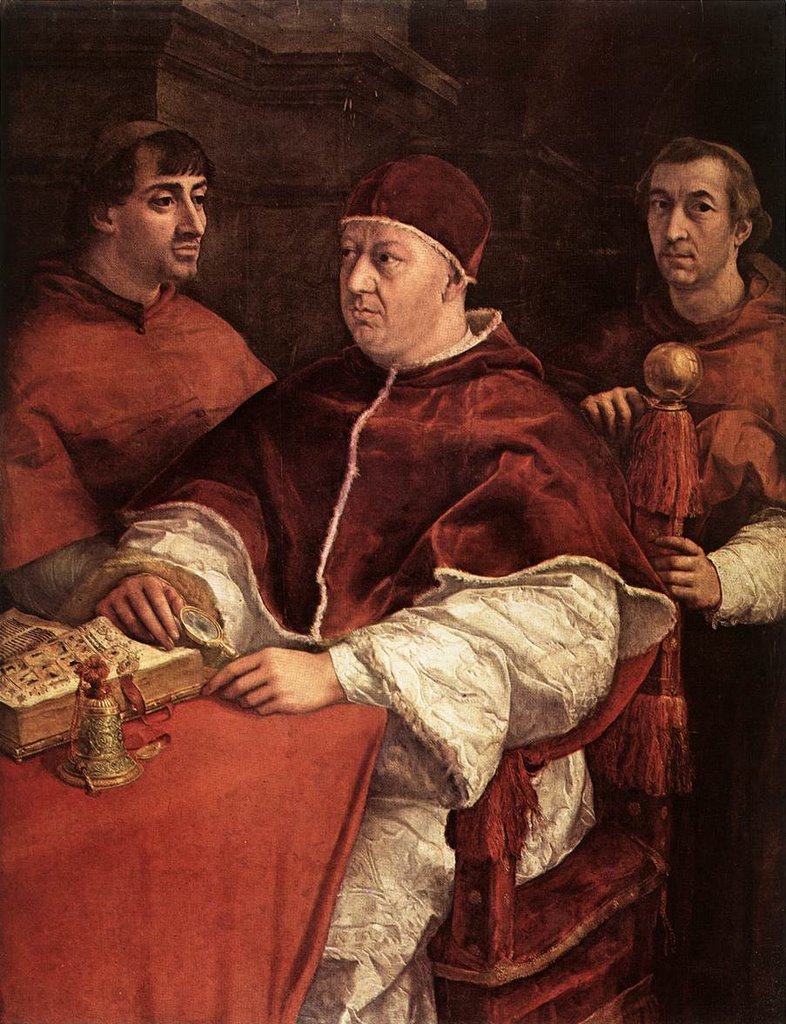
P.S. - Pope Leo X features twice in this list, so I included a portrait of him.
Wednesday, July 26, 2006
Creation, Evolution, and Karl Rahner

I'm already on record as a great fan of Karl Rahner, despite certain deficiencies in his understanding of the Trinity. One of the reasons for this is because of his brilliant presentation of Man's place in the cosmos, assuming an evolutionary model of humanity's origin and development (see previous entry below).
Somewhere between the intransigent young-earth creationist and the godless naturalistic evolutionist lies the much maligned and much misunderstood theistic evolutionist. To the creationist, the theistic evolutionist is a personified oxymoron trying in vain to bridge a gap between two mutually exclusive ideas. At the same time, the naturalist evolutionist pours scorn over his theistic counterpart's head on account of the latter's irrational attachment to pre-scientific myths and an outmoded worldview.
I freely admit that I am agnostic on this issue, not because I'm disinterested in it or feel it unimportant. Indeed, nothing could be further from the truth! Rather it is because I am a non-expert in the area of science who, over the years, has become increasingly and ever so confidently convinced of three things: (1) that the jury is still out; (2) that it is best to keep an open mind about such things while it is; and (3) that, no matter what verdict the jury returns, Christian theology has proven itself over and over again to be able to survive and adapt to seismic shifts in the way we understand the world around us (recall Galileo).
I have yet to come across an irrefutable creationist argument. On the other hand, I am not the least persuaded that evolutionists have made their case beyond all reasonable doubt. While I find the intelligent design theory of William Dembski et al. intriguing, if not very compelling, I can't help but observe that intellent design works just as well with an evolutionary model as it does with fiat-creationism. I think the young-earth brand of creationism is scientifically untenable, but then again, it's no more untenable than a theory of punctuated equalibrium that assumes a random universe.
However, if I did affirm theistic evolution (remember I'm agnostic on this issue) I would undoubtedly follow Rahner's version of it. He does not merely show how an evolutionary model can work within a Christian theological framework. Rather he gives a cogent account of why this model (to his mind) is superior in all respects to earlier cosmological models in its presentation of the Christian faith. I got to hand it to Rahner. Before reading him it was very convenient to dismiss theistic evolutionism as just another example of capitulation to the prevailing culture by Christians inadequately grounded in their faith.
If you're at all interested in this topic, read the entry below and feel free to make comment.
Until next time.
Tuesday, July 25, 2006
Karl Rahner's understanding of Man's place in the Cosmos within an evolutionary worldview
In spite of the magnificent results and perspectives of science, even the modern natural scientist, and the rest of us too who share this mentality, still remain to a large extent really imprisoned in a pre-scientific as well as a pre-philosophical and pre-theological perspective. For even today he and we along with him usually think at the unconscious and unreflexive level that it belongs precisely to the spirit of natural science to see man as a weak and incidental being who is exposed to a nature which is indifferent to him, until finally he is swallowed up again by a "blind" nature. It is only by a kind of schizophrenia that we have anything like a conception of man's dignity and abiding value and of the unique existence of each person. But the notion that man is an accidental and really unintended product of the history of nature, a caprice of nature, contradicts not only metaphysics and Christian faith, but basically it also contradicts natural science itself. If man does exist, and precisely if he is the "product" of nature, if he appears not just at any time at all, but at a definite point in this development, a point at which he himself can even direct this development at least partially by the fact that he now objectifies it and stands over against what has produced him, and transforms the producer itself, then this very nature become conscious of itself in him. But then it is directed towards him because "chance" is not a meaningful term for natural science, and the natural scientist infers from the result at least a movement directed towards it.
If we do not see it this way, then it makes no sense at all to see the history of the cosmos and that of man as a single history. But then human thought will sooner or later fall back into a platonic dualism again, for spirit will then have to feel like a stranger who is on earth by chance, and it will not allow itself for long to be disdained and abused as insignificant and powerless. If spirit is not regarded as the goal of nature itself, and if it is not seen that nature finds itself in spirit in spite of all the physical powerlessness of the individual person, then in the long run man will only be able to have validity as the disparate adversary of nature, and he will form this estimate of himself.
--Karl Rahner, Foundations of Christian Faith (1978), pp. 188-9.
The Uncertain Future of Anglicanism in a Nutshell

I'm often asked privately why I don't spend much time commenting on the present crises threatening the Anglican Communion or making predictions about the future of Anglicanism. Well, I'm about to break my relative silence with a thesis so simple that even the most the hardline "reasserter" or hard-core "reappraiser" can understand it.
My thesis is this: Both Archbishop Akinola of Nigeria and Presiding Bishop-elect Jefferts-Schori are poised and prepared to "walk apart" from the rest of the Communion, but only one of them needs to. If Akinola stands firm for the Communion then Schori and company will be forced to walk apart. If Akinola and company bolts, then Schori can rest easy. The first is a victory for Anglican catholicity; the second will effectively end the Anglican Communion experiment, which, in the eyes of many, will have proven to have been nothing more than a collection of protestant sects.
As for me, I'm content to reside in a diocese under a Windsor compliant bishop.
Saturday, July 22, 2006
The Church of Nigeria and the Anglican Communion: a dire prediction
Father Jones makes a dire prediction about the designs of the Church of Nigeria over at The Anglican Centrist, and I think he may be on to something. Cruise on over to his blog for the details.
--Yet another biretta tip to Brett over at Pennsylvanian-Anglican
Friday, July 21, 2006
The Foolishness of John Hagee

"The Jews have no greater enemy than Christian Zionists."
--Recent comment from my friend, Mark Talley
See Pastor John Hagee spearheads Christians United for Israel
Also see Israpundit
Vatican official to Anglicans: Women bishops would destroy unity
Old news, but worthy of our consideration...
By Simon Caldwell Catholic News Service LONDON (CNS) --
A Vatican cardinal has warned the Church of England that a move to ordain women as bishops would destroy any chance of full unity with the Catholic and Orthodox churches.
Cardinal Walter Kasper, president of the Pontifical Council for Promoting Christian Unity, said that if the Church of England adopted such a resolution the "shared partaking of the one Lord's table, which we long for so earnestly, would disappear into the far and ultimately unreachable distance."
"Instead of moving toward one another, we would simply coexist alongside each other," he said.
His remarks came in a speech to a private meeting of the Church of England bishops in Market Bosworth, England, just four months after the bishops agreed to set up a working group to outline a process through which women might be consecrated as bishops.
Although three of the world's Anglican provinces have already agreed to consecrate women as bishops, Cardinal Kasper said decisions made by the Church of England had a "particular importance" because they gave a "strong indication of the direction in which the communion as a whole was heading."
Saying that he spoke with "pain and sadness," the cardinal warned the bishops of their historic decision's grave consequences, both to ecumenical relations and to the interior unity of the Anglican Communion.
Among the most serious of these, he said, would be that the goal of restoring full church communion "would realistically no longer exist" because it could not exist "without full communion in the episcopal office."
A decision in favor of women bishops made broadly by the Anglican Communion, he said, would also represent a turning away from the "common position of all the churches of the first millennium."
He said this meant that the Anglican Communion would no longer occupy "a special place" among the churches of the West but would align itself closely to the Protestant churches of the 16th century.
Cardinal Kasper said that although ecumenical dialogue would continue the loss of a common goal would "rob such encounters of their elan and their internal dynamic."
He said a further consequence of a resolution in favor of women bishops would be that the Catholic Church would inevitably continue to refuse to recognize the validity of Anglican orders.
He said that ecumenical discussions between the churches on "Apostolicae Curae," the 1896 papal bull that declared Anglican orders "absolutely null and utterly void," had "justifiably aroused promising expectations" of a change in the Catholic position. But he said that the growing practice of the ordination of women to the priesthood had since led to an "appreciable cooling" of such discussions.
The ordination of women bishops, Cardinal Kasper added, would "most certainly lower the temperature even more; in terms of the possible recognition of Anglican orders, it would lead not only to a short-lived cold, but to a serious and long-lasting chill."
Addressing the subject of the interior unity of the Anglican Communion, the cardinal said that the episcopal office was essentially one of unity and, therefore, any consecration that either caused schism or blocked the way to full unity would be intrinsically contradictory.
He criticized a proposal by the Church of England House of Bishops to remedy such divisions by allowing parishes that rejected women bishops to choose to be cared for by a male traditionalist bishop."
Where mutual recognition and communion between bishops does not exist or no longer exists, where one can therefore no longer concelebrate the Eucharist, then no church communion, at least no full church communion and thus no eucharistic communion can exist," he said. "Arrangements like those I have referred to can only cover over the breach superficially; they can paper over the cracks, but they cannot heal the division; one can even go one step further and say that, from the Catholic perspective, they are the unspoken institutionalization, manifestation and virtual legitimating of an existing schism."
Cardinal Kasper said that Pope John Paul II had made it clear that the church's position on women's ordinations "in no way rose from a denial of the equal dignity of men and women ... but is based solely on the fidelity to apostolic testimony as it has been handed down in the church throughout the centuries."
Cardinal Kasper was among a number of speakers invited to address the meeting by Anglican Archbishop Rowan Williams of Canterbury, head of the worldwide Anglican Communion.
In a statement June 6, Archbishop Williams said nothing was achieved by avoiding hard questions and that he appreciated the spirit with which the cardinal had shared his concerns."
As we consider whether women should be ordained as bishops in the Church of England and what shape any possible legislation should take, it is important to have this kind of honesty and clarity about how changes made here might impact upon the common commitments of our two communions to the search for full visible unity in Christ's church," he said.
The archbishop is scheduled to go to Rome in the fall for his second meeting with Pope Benedict XVI.
END
--Biretta tip to Bret over at Pennsylvanian-Anglican
By Simon Caldwell Catholic News Service LONDON (CNS) --
A Vatican cardinal has warned the Church of England that a move to ordain women as bishops would destroy any chance of full unity with the Catholic and Orthodox churches.
Cardinal Walter Kasper, president of the Pontifical Council for Promoting Christian Unity, said that if the Church of England adopted such a resolution the "shared partaking of the one Lord's table, which we long for so earnestly, would disappear into the far and ultimately unreachable distance."
"Instead of moving toward one another, we would simply coexist alongside each other," he said.
His remarks came in a speech to a private meeting of the Church of England bishops in Market Bosworth, England, just four months after the bishops agreed to set up a working group to outline a process through which women might be consecrated as bishops.
Although three of the world's Anglican provinces have already agreed to consecrate women as bishops, Cardinal Kasper said decisions made by the Church of England had a "particular importance" because they gave a "strong indication of the direction in which the communion as a whole was heading."
Saying that he spoke with "pain and sadness," the cardinal warned the bishops of their historic decision's grave consequences, both to ecumenical relations and to the interior unity of the Anglican Communion.
Among the most serious of these, he said, would be that the goal of restoring full church communion "would realistically no longer exist" because it could not exist "without full communion in the episcopal office."
A decision in favor of women bishops made broadly by the Anglican Communion, he said, would also represent a turning away from the "common position of all the churches of the first millennium."
He said this meant that the Anglican Communion would no longer occupy "a special place" among the churches of the West but would align itself closely to the Protestant churches of the 16th century.
Cardinal Kasper said that although ecumenical dialogue would continue the loss of a common goal would "rob such encounters of their elan and their internal dynamic."
He said a further consequence of a resolution in favor of women bishops would be that the Catholic Church would inevitably continue to refuse to recognize the validity of Anglican orders.
He said that ecumenical discussions between the churches on "Apostolicae Curae," the 1896 papal bull that declared Anglican orders "absolutely null and utterly void," had "justifiably aroused promising expectations" of a change in the Catholic position. But he said that the growing practice of the ordination of women to the priesthood had since led to an "appreciable cooling" of such discussions.
The ordination of women bishops, Cardinal Kasper added, would "most certainly lower the temperature even more; in terms of the possible recognition of Anglican orders, it would lead not only to a short-lived cold, but to a serious and long-lasting chill."
Addressing the subject of the interior unity of the Anglican Communion, the cardinal said that the episcopal office was essentially one of unity and, therefore, any consecration that either caused schism or blocked the way to full unity would be intrinsically contradictory.
He criticized a proposal by the Church of England House of Bishops to remedy such divisions by allowing parishes that rejected women bishops to choose to be cared for by a male traditionalist bishop."
Where mutual recognition and communion between bishops does not exist or no longer exists, where one can therefore no longer concelebrate the Eucharist, then no church communion, at least no full church communion and thus no eucharistic communion can exist," he said. "Arrangements like those I have referred to can only cover over the breach superficially; they can paper over the cracks, but they cannot heal the division; one can even go one step further and say that, from the Catholic perspective, they are the unspoken institutionalization, manifestation and virtual legitimating of an existing schism."
Cardinal Kasper said that Pope John Paul II had made it clear that the church's position on women's ordinations "in no way rose from a denial of the equal dignity of men and women ... but is based solely on the fidelity to apostolic testimony as it has been handed down in the church throughout the centuries."
Cardinal Kasper was among a number of speakers invited to address the meeting by Anglican Archbishop Rowan Williams of Canterbury, head of the worldwide Anglican Communion.
In a statement June 6, Archbishop Williams said nothing was achieved by avoiding hard questions and that he appreciated the spirit with which the cardinal had shared his concerns."
As we consider whether women should be ordained as bishops in the Church of England and what shape any possible legislation should take, it is important to have this kind of honesty and clarity about how changes made here might impact upon the common commitments of our two communions to the search for full visible unity in Christ's church," he said.
The archbishop is scheduled to go to Rome in the fall for his second meeting with Pope Benedict XVI.
END
--Biretta tip to Bret over at Pennsylvanian-Anglican
Sunday, July 16, 2006
Blog neglect...
Yes, I know my blog's been inactive of late. I've just come off two very long weeks at work and extracurricular activities (a little moonlighting, and preaching at my church). I'll be back this week with a couple of new entries.
Until then.
Until then.
Wednesday, July 12, 2006
Ephraim Radner's response to Matt Kennedy
The guys over at the Anglican Communion Institute (ACI) are absolutely brilliant. Follow this link to check out Ephraim Radner's timely and excellent response to Stand Firm's Matt Kennedy.
Monday, July 10, 2006
The Text that Luther Hated: 2 Maccabees 12:38-45
(38) Then Judas assembled his army and went to the city of Adullam. As the seventh day was coming on, they purified themselves according to the custom, and they kept the sabbath there. (39) On the next day, as by that time it had become necessary, Judas and his men went to take up the bodies of the fallen and to bring them back to lie with their kinsmen in the sepulchres of their fathers. (40) Then under the tunic of every one of the dead they found sacred tokens of the idols of Jamnia, which the law forbids the Jews to wear. And it became clear to all that this was why these men had fallen. (41) So they all blessed the ways of the Lord, the righteous Judge, who reveals the things that are hidden; (42) and they turned to prayer, beseeching that the sin which had been committed might be wholly blotted out. And the noble Judas exhorted the people to keep themselves free from sin, for they had seen with their own eyes what had happened because of the sin of those who had fallen. (43) He also took up a collection, man by man, to the amount of two thousand drachmas of silver, and sent it to Jerusalem to provide for a sin offering. In doing this he acted very well and honorably, taking account of the resurrection. (44) For if he were not expecting that those who had fallen would rise again, it would have been superfluous and foolish to pray for the dead. (45) But if he was looking to the splendid reward that is laid up for those who fall asleep in godliness, it was a holy and pious thought. Therefore he made atonement for the dead, that they might be delivered from their sin.
Aidan Nichols, O.P.: On Purgatory and Prayers for the Dead

Here are some thoughts from my favorite Roman Catholic author and theologian, Aidan Nichols, O.P. The "money statement" is in the last paragraph in bold print (emphasis mine).
In her dogmatic teaching, the Catholic Church speaks with discretion of the intermediate state. In 1979 the Congregation for the Doctrine of the Faith in its Letter on Certain Questions concerning Eschatology declared: "The Church believers there may be purification of the elect previous to the vision of God, which is nevertheless totally different from the pains of the damned." About the "place" of this purification, its duration, and its manner the teaching office of the Church falls silent, leaving the question to spiritual tradition. In that tradition we find a number of images: in the Alexandrian Fathers, Athanasius and the Cappadocians, purification by fire (where "fire" may represent the intensity of desire for God); in the Cappadocians and Ambrose of Milan, an opening of the paradise gates guarded as these are by the cherubim and the flaming sword; in Athanasius and the Desert Fathers, stages along the roads leading to heaven.
The crucial thing to note is that, in the Church's vision, the "holy souls" deserve our prayers because of their goodness. Their presence in purgatory is proof of their faith, hope, and charity. The alms Christian bestow in the cultus of the dead is par excellence charity to the poor: the holy dead are the most deserving poor of all. The souls in Thomas More's Supplycacyon put it simply: "Remember, friends, how nature and Christendom [=baptism] bindeth you to remember us." The Gaelic tradition of the western isles of Scotland calls purgatory the "Hell of the Holy Fathers," and sees Christ's people purified there
Till they are whiter the the swan of songs,
Till they are whiter than the seagull of the waves,
Till they are whiter than the snow of the peaks,
And whiter than the white love of the heroes.
The Protestant rejection of purgatory (and prayer for the dead) is seen by Catholicism as based on a mistaken interpretation of the mediation of Christ. Christ's mediation of human salvation is indeed unique and all-sufficient, but it is not separated from the prayer of his Church. The head and the body are one, and the head's glory as Savior is the greater in that he encourages the body to share in the communication to the whole human mass of the effects of his redeeming work. What the Lord has done for us in his mighty salvation he grants to us to do ourselves. The continuum of life in Christ is more primary than the biological continuum. As sharers, in via, of the life of Christ who called himself "the way," we (super)naturally wish both to pray for the holy souls and to seek their prayers.
--Aidan Nichols, Epiphany: A Theological Introduction to Catholicism (Liturgical Press, 1996), pp. 197-8.
Until next time.
P.S. That I describe Nichols, a Dominican, as "my favorite Roman Catholic author and theologian," demonstrates that, yes, I do think one can occasionally learn something from a Thomist.
Wednesday, July 05, 2006
Karl Rahner on the Holy Trinity
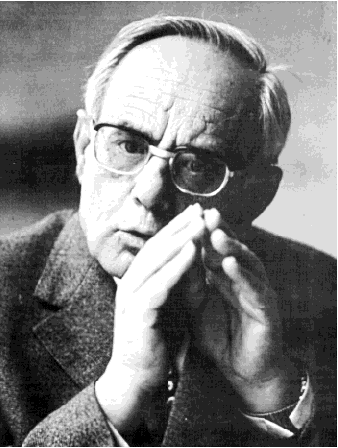
Alright, I confess: I like Karl Rahner. He is difficult to read, even exasperating at times. I can only take him in small doses, but he makes me think even though I often find myself at variance with him. The way I see it he's worth the effort if only for the fact that he is perhaps the most important Roman theologian of the 20th century.
In particular I am attracted to Rahner's concept of human transcendence and how this relates to the Incarnation. But recently, in light of the discussions on this blog, I decided to review what he had to say about the Trinity in his monumental Foundations of Christian Faith (English translation, 1978). While I can't say that I was totally surprised to find elements of modalism in his understanding of the Trinity (after all, he is cut out of the same western Augustinian cloth), I will admit that I was shocked to see how blatent his modalism was. The following is an example of what I mean. What do you think?
Insofar as he has come as the salvation which divinizes us in the innermost center of the existence of the individual person, we call him really and truly "Holy Spirit" or "Holy Ghost." Insofar as in the concrete historicity of our existence one and the same God strictly as himself is present for us in Jesus Christ, and in himself, not in a representation, we call him "Logos" or the Son in an absolute sense. Insofar as this very God, who comes to us as Spirit and Logos, is and always remains the ineffable and holy mystery, the incomprensible ground and origin of his coming in the Son and in the Spirit, we call him the one God, the Father. Insofar as in the Spirit, in the Logos-Son, and in the Father we are dealing with a God who gives himself in the strictest sense, and not something else, not something different from himself, we must say in the strictest sense and equally of the Spirit, of the Logos-Son and of the Father that they are one and the same God in the unlimited fullness of the one Godhead and in possession of one and the same divine essence.
--Foundations of Christian Faith, p. 136.
Prayers for the Dead
I'm soon to share my thoughts and embark on a discussion of the Christian practice of praying for the dead. To prime the pump, so to speak, I've included the Catechism question from the '79 BCP on the subject below.
If you're curious as to what my approach will be, I encourage you to read my earlier thoughts on the somwhat related issue of the Invocation of the Saints, which can be accessed here, here, and here.
Until then...
Q. Why do we pray for the dead?
A. We pray for them, because we still hold them in our love, and because we trust that in God's presence those who have chosen to serve him will grow in his love, until they see him as he is. (Catechism of the 1979 Book of Common Prayer)
Tuesday, July 04, 2006
Check out Trinitarian Life
For those interested,Trinitarian Life has a couple of recent articles on Aquinas' views of Person and Relations in the Godhead.
Monday, July 03, 2006
Check out Thomas' Blog
I just added Thomas Poynor's Hagia Sapentia to my blog list.
Check it out HERE.
Check it out HERE.
Saturday, July 01, 2006
Gerald Bray "Gets It": His Discussion of Thomas Aquinas

Aquinas' debts to Augustine and Anselm are obvious, but he was determined to go beyond them and establish a clear distinction between the two divine 'processions', generation and procession (in the classical sense). 'Generation' was defined by Aquinas as an (intellectual) act of conception which produced its like, i.e. the Father reproduced his own likeness in the Son. 'Procession' he defined as an impulse of the divine will, which brings forth something other than a straightforward reproduction of itself. When this impulse is perfect, as it must be within the Godhead, the resulting product will also be fully God. Hence there is a real difference between the Son and the Holy Spirit, both of whom are fully God, although once again the Spirit fits only somewhat uncomfortably into what is basically an Augustinian model of the Trinity.
Not content to stop there, Aquinas used the terms 'paternity', 'filiation' and 'procession' to describe the divine relations. He distinguished them from the essence of God by saying that the former are relative, while the latter is absolute. His abstractions differ from those of the Cappadocians, for whom unbegottenness, begottenness and procession were the absolute distinctions of the hypostases. But like them, he has succumbed to a tendency towards philosophical abstraction which is very different from the spirit of the New Testament. The full effect can be seen in Thomas' definition of the word 'person'. As far as he was concerned, person was an aspect of a nature which signified what was distinct in that nature. Because distinction in God is only by relations of origin, a divine person is defined by Aquinas as a subsistent relation in the being of God. In other words, 'person' and 'relation' are synonymous, which means that one might easily dispose of the unphilosophical term 'person' and speak only of (Aristotelian) relations in God.
The trinitarianism of Anselm and Aquinas can rightly be criticized for being too philosophical, too abstract, and even reactionary, in the sense that it is dependent on the primacy of nature over person -- almost inevitable in any philosophical theology, but directly counter to the spirit of Chalcedonian christology. Unfortunately, christology and trinitarian theology tended to go their separate ways during the high Middle Ages, and they are still not always closely linked even today.
--Gerald Bray, The Doctrine of God (IVP, 1993), pp. 182-3
Friday, June 30, 2006
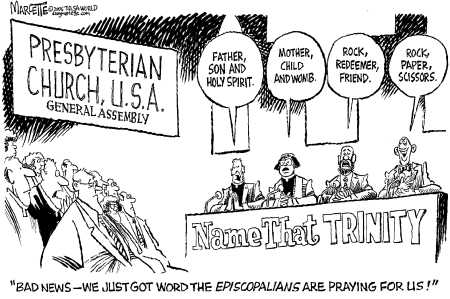
Thursday, June 29, 2006
The Dark Lord of the Sith chimes in...
"The subordination of the Persons to the essence, inherent in the structure of his theology, also provides Augustine with the means to attempt to distinguish the Persons from each other. Having assumed an absolute simplicity, the Persons can no longer be absolute hypostases, but are merely relative terms to each other, thus occuring on an even lower plane than the attribute proper. 'The terms (Father, Son, and Holy Spirit) are used reciprocally and in relation to each other' [Augustine De Trinitate, 1:8:15]. There is a subtle, but nevertheless, real play of the dialectic of oppositions here. One no longer begins with the Three Persons and then moves to consider their relations, but begins with their relative quality, the relation between the Persons, itself. In other words, there is an artificial opposition of one Person to the other two. It is at this point that the flexibility of Augustine's Neoplatonic commitment begins to surface in a more acute form."
--Joseph Farrell, Introduction to The Mystagogy of the Holy Spirit of our Father among the Saints, Photius the Great, Patriarch of Constantiople (2001), p. xx-xxi.
Wednesday, June 28, 2006
Soundbite from Saint Photius the Great

"For it is not, I repeat, not the nature -- in other words, that which is common among the Three Hypostases -- which is worshipped, but the specific personal distinctions whereby the Hypostases of the Trinity are distinguished."
--Patriarch Photius, Concerning the Mystagogy of the Holy Spirit, 47 (translation by Joseph Farrell).
Tuesday, June 27, 2006
Quiz: Which of the following statements is the orthodox one?
(1) In Scripture, God reveals His Trinitarian nature as Father, Son, and Holy Spirit.
OR
(2) In Scripture, God reveals Himself as the Father of Jesus Christ our Lord, and the One from whom the Holy Spirit proceeds.
MULTIPLE CHOICE:
A. Number 1.
D. Neither is orthodox.
OR
(2) In Scripture, God reveals Himself as the Father of Jesus Christ our Lord, and the One from whom the Holy Spirit proceeds.
MULTIPLE CHOICE:
A. Number 1.
B. Number 2.
C. Both statements are equally orthodox.D. Neither is orthodox.
Monday, June 26, 2006
What did Augustine and Arius have in common?
Answer: Both Arius and Augustine defined deity in terms of divine causality, thus understanding causality to be the essential attribute of deity rather than the hypostatic (i.e. personal) feature of the Father's monarchy.
In this confusion of Person, nature and attribute, Arius went on to assert that only the Father was truly God, for the Logos was begotten of the Father. Thus Christ could not be fully divine in that he was "caused by," and in no way the "cause of," the Father. Divine causality and essential deity are inextricably mixed.
In his argument against the later heresy of semi-Arianism, Augustine conceded this point, but went on to employ it in favor of the essential deity of Christ by positing the filioque doctrine. Thus Augustine saw the Son as the "cause," along with the Father, of another divine Person: the Holy Spirit. "For if the Son has of the Father whatever He has, then certainly He has of the Father that the Holy Spirit proceeds also from Him" (De Trinitate 15:26:47). In other words, the Son receives divine causality from the Father and thus is fully divine, for the Holy Spirit proceeds from both.
At this point the inconsistency in Augustine's view of the Trinity becomes apparent, for where does this leave the Holy Spirit? If the Holy Spirit is a fully divine hypostasis then wherein is manifested the attribute of causality?
Food for thought.
Until next time.
P.S. I am indebted to my friend, Dr. Joseph Farrell (+Photius), for these insights.
Augustine's Confusion of Nature, Attribute, and Person in the Godhead

He is called in respect to Himself both God, and great, and good, and just, and anything else of the kind; and just as to Him to be is the same as to be God, or to be great, or as to be good, so it is the same thing to Him to be as to be a person (De Trinitate 7:6:11, from Schaff's The Nicene and Post-Nicene Fathers [1st series], pp. 111-12).
Friday, June 23, 2006
WARNING CONTROVERSIAL SUBJECT: Top Ten Reasons Why I Don't Particularly Like the Quicunque Vult
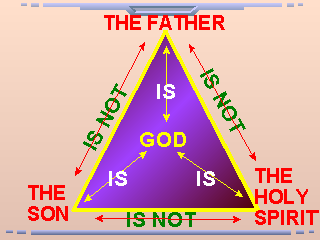
The Quicunque Vult (QV), as most of you probably know, is the Latin name for the Athanasian Creed, which I contend is neither Athanasian nor a creed (to borrow Votaire's turn of phrase). What has prompted this rant, you ask? The answer is the events that took place within two mainline denominations in the last two weeks.
Truth be told, I'm not ready yet to talk about the events of the General Convention of TEC, so I thought I'd focus on (i.e. "pick on") the other mainline denomination that recently held their national assembly: the Presbyterians (check out this link). Call it therapy.
So what does the Quicunque Vult have to do with the recent Presbyterian decision to allow the liturgical usage of other Trinitarian formulae such as "Mother, Child, and Womb" or "Rock, Redeemer, Friend" (or "Larry, Moe, and Curly" for that matter)? Well, admittedly, there is no direct connection. However, I believe that the QV is illustrative of a fundamental misstep within Western Trinitarian thought, which in turn may help to explain how it is possible that a once great Protestant denomination could have fallen so far.
And for the record: Don't mistake my misgivings for the QV as a rejection of the Holy Trinity or the Chalcedonian Definition. I am THOROUGHLY Trinitarian and Chalcedonian in my faith. However, I am not a Filioquist.
So here it goes. My top ten reasons:
10. Unlike the Nicene and Apostles’ Creeds, the QV is neither a conciliar symbol nor a baptismal symbol. In other words, it’s not really a creed.
9. The QV is liturgically cumbersome, aesthetically jarring, and impossible to chant.
8. The QV is not ecumenical, as the Eastern churches, apart from a few isolated cases (sans filioque), do not recognize it or use it.
7. The QV implicitly condemns the Non-Chalcedonian churches (i.e. Oriental Orthodox), whose Christology has been shown in recent years to be within acceptable bounds.
6. The QV was not really written by Athanasius, despite its popular ascription.
5. To assert that the QV actually represents the theology of Athanasius is not only anachronistic, it is highly presumptuous.
4. The QV includes filioquist language.
3. The QV does not fit or conform to the biblical paradigm in that it begins with a consideration of the essence of God prior to any consideration of the distinct Persons of the Godhead, i.e., going from the abstract to the concrete. (Note that the Nicene Creed first confesses the Persons, and then goes on to explicate essence only with respect to the derivation of the Son and the Spirit from the Father.)
2. In light of the above, a very good case could be made that the QV contributes to the Western exaltation of philosophy over revelation.
1. The QV is symptomatic of a Neo-Platonist tendency in much of Western Trinitarian thought. It's this tendency that gets denominations like the PCUSA and TEC into trouble.
More on this later if people are interested.
Monday, June 19, 2006
What Do You Think? (Question to My Readers): How will Canterbury respond to TEC?

P.S. Where's ol' Winnie when we need him?
Friday, June 16, 2006
Barth and Synergism

In response to a question from a reader an earlier entry, I stated that "Barth's actualist soteriology has had such a profound impact on my own approach to theology that, as an Anglican and a Catholic, I find myself SET FREE to entertain and explore more synergistic models as relating to the existential moment of salvation."
Recently I've been reading another work by Hunsinger called Disruptive Grace (Eerdmans, 2000), which is a collection of studies that he wrote on Barth's Theology. In his article, "The Mediator of Communion: Karl Barth's Doctrine of the Holy Spirit" (1999), Hunsinger had this to say about Barth's understanding of human cooperation with divine grace:
Barth does not deny that human freedom "cooperates" with divine grace. He denies that this cooperation in any way effects salvation. Although grace makes human freedom possible as a mode of acting (modus agendi), that freedom is always a gift. It is always imparted to faith in the mode of receiving salvation (modus recipiendi), partaking of it (modus participandi), and bearing witness to it (modus testificandi), never in the mode of effecting it (modus efficiendi). As imparted by the Spirit's miraculous operation, human freedom is always the consequence of salvation, never its cause, and therefore in its correspondence to grace always eucharistic (modus gratandi et laudandi) [p. 165].
In an insightful footnote at the end of this last sentence Hunsinger observes that Barth's position brought about an "implicit resolution of the sixteenth-century 'synergist' controversy between the Philippist and Gnesio-Lutherans." Essentially Barth's position transcends the issue by taking something from each side of the dispute. With the Philippists, Barth acknowledges a true freedom in and the positive nature of the human response to the offer of divine grace, i.e. a "mode of acting" (modus agendi). With the Gnesio-Lutherans, Barth acknowledges the utter incapacity of human beings, in and of themselves, to respond to God's grace. The dispute hinged on whether faith was active or passive. The Philippists argued for a coincidence of the Word, the Spirit, and the human will in not refusing divine grace, which position the orthodox (i.e. Gnesio) Lutherans denied (and thus consequently excluded from the Formula of Concord). Barth's actualist soteriology allows for the Philippist idea of a coincidence of Word, Spirit, and human will by insisting that human freedom "is always a consequence of salvation, never its cause." For Barth, the human response is in nature "eucharistic" (i.e. thanksgiving and praise), not salvific -- thus addressing orthodox Lutheran concerns.
Alas, while I'm simply thrilled with Hunsinger's observation and application of Barth's theology to the Lutheran synergistic disputes, he leaves us begging the question: how might Barth's theology prove itself to transcend other Reformation/post-Reformation debates on these issues (e.g., Calvinist/Arminian; Protestant/Roman Catholic)? I intend to explore this matter more.
Until next time.
P.S. Incidentally, Pontifications recently posted an excerpt from E.L. Mascall's The Recovery of Unity (1958) that brings up this same Gnesio-Lutheran conundrum (namely, how can faith be conceived of as the one human act that is not a work?), attributing the problem to the underlying philosophical Nominalism of Luther's position. Personally, I think Mascall's argument is right on target. But I also happen to think Barth's "realism" addresses the conundrum rather well.
P.P.S. I found my copy of and I'm currently re-reading Hans Küng's Justification: The Doctrine of Karl Barth and a Catholic Reflection. I should have some insightful excerpts and/or some of my own reflections up on my blog over the weekend. 'Til then...
Wednesday, June 14, 2006
Hans Küng on Karl Barth
I found the following review of Hans Küng's Justification: The Doctrine of Karl Barth and a Catholic Reflection at this Link. Here's what Barth had to say about Küng's analysis and critique:
"The positive conclusion of your critique is this: What I say about justification—making allowances for certain precarious yet not insupportable turns of phrase—does objectively concur on all points with the correctly understood teaching of the Roman Catholic Church. You can imagine my considerable amazement at this bit of news; and I suppose that many Roman Catholic readers will at first be no less amazed—at least until they come to realize what a cloud of witnesses you have produced in support of your position. All I can say is this: If what you have presented in Part Two of this book is actually the teaching of the Roman Catholic Church, then I must certainly admit that my view of justification agrees with the Roman Catholic view."
P.S. Note the figure standing in the background of Küng's portrait above. Interesting.
Tuesday, June 13, 2006
A Modest Proposal: Barthian Implications on the Question of Justification's Formal Cause

Over at Pontifications I came across Al Kimel's recent discussion of the doctrine of Justification (We Can Earn it to Lose it). He begins with a quote from Matt Kennedy's recent posting at Stand Firm where Matt attempts to give a brief description of the differences between Anglican Evangelicals and Anglican Catholics on the question of justification.
I don't intend to critique either blogger in this entry. I merely point out these examples to illustrate that the main issue that continues to divide Western Christians -- Catholics and Protestants -- hasn't changed much in nearly five centuries with regard to the way the arguments on both sides have been presented; nor is this an issue that is going away anytime soon, despite genuine attempts on both sides to achieve rapprochement on what Luther described as the "articulus stantis vel candentis ecclesiae."
For theologians, this debate has not been so much about whether faith or works or some combination of the two justifies a person, as is popularly thought; but rather it has been about how theologians have answered the question "What is justification's formal cause?" For example, is the formal cause of the justification of the sinner the imputed alien-righteousness of Christ as most Protestants claim? Or are we justified by the gracious "supernaturalization of our natures" (to borrow Al Kimel's apt description of the Council of Trent's teaching on the matter)?
I'd like to make a modest proposal here, one suggested by Barth's actualist theology. I am particularly impressed by the strong distinction that Barth makes between the objective and existential moments of salvation. Despite many centuries of polemical hashing and rehashing on the subject, I suggest that Barth's insights might just serve to expose the inherently anthropocentric underpinnings and assumptions of the theological approaches of BOTH sides of this issue. If (as Barth's interpreter George Hunsinger describes it) the actuality and truth of our salvation does not depend on the existential occurrence of it, but rather the existential occurence of salvation is brought about by the actuality and truth of it, then it is simply wrongheaded to ground the event and occurrence of justification in something that happens to or within the individual sinner (whether as something imputed to, imparted to, or even "supernaturalized" within a person).
Rather a truly Christocentric approach to this issue would see the "formal cause" of justification (i.e., the actuality of salvation) as the ontological and vicarious identification of Christ with ALL humankind, which (as an existential encounter) becomes true for us even as we begin to recognize that it has always been true apart from us, and even against us. As St. Paul says, "...While we were yet sinners, Christ died for us" (Romans 5:8).
Until next time.
Sunday, June 11, 2006
Divine Grace and Human Freedom in Barth
'Divine grace and human freedom, as Barth understood them, can be conceptualized only by means of an unresolved antithesis. They cannot be systamatized or captured by a unified thought. Any attempt at resolving the antithesis will only result either in a false determinism (the risk run by Luther and Calvin) or in a false libertarianism (the risk run by Augustine and Aquinas). Barth's alternative to thinking in terms of a system here was to think in terms of the Chalcedonian pattern. Grace and freedom existed in the life of faith "without separation or division," "without confusion or change," and according to an "asymmetrical" ordering principle. "Without separation or division" meant that no human freedom occurred without grace, and no divine grace occurred at the expense of freedom. Grace granted the freedom for God that human beings were completely incapable of by nature, no only before but also continually after awakening to faith. Grace and freedom also existed "without confusion or change." Divine grace always remained completely unconditioned, even as human freedom always remained completely dependent on grace ... Finally, grace and freedom were related according to an asymmetrical ordering principle. Human freedom was a completely subordinate and dependent moment within the event of grace.'
--G. Hunsinger, "What Karl Barth Learned from Martin Luther" in Disruptive Grace: Studies in the Theology of Karl Barth (Eerdmanns, 2000), p. 302.
Jeremy Taylor's Doctrine of Eucharistic Presence
I just came across this very insightful paper on Jeremy Taylor's doctrine of Eucharistic Presence, which argues for a continuity of Anglican thought from Cranmer and Hooker thru Andrewes and Taylor. I'd love to hear some feedback. Enjoy!
http://www.kerygma.org/lee/papers/Taylor.pdf
Friday, June 09, 2006
Truth as Encounter: Part 3
This is the last installment from Hunsinger's work on Karl Barth that I intend to post before beginning the "Justification and Catholicity in the Third Millennium" thread, and it contains the most important seed for our discussion. Readers take note that (according to Hunsinger) Barth grounds justification/sanctification in the objective moment of salvation and sees vocation as the primary locus under which to explicate a theology of the Christian life and experience.
'The existential moment of salvation (as established through the event of encounter) is, it is important to see, understood primarily in terms of vocation rather than justification or sanctification. Justification and sactification are primarily conceived, in Barth's theology, as the objective aspects of salvation to which vocation is the corresponding existential aspect. Thus as Barth moves into part 3 of volume 4 of Church Dogmatics, where vocation is discussed, a much more recurrent and prominent use of "in us" can be found than in parts 1 and 2, where justification and sanctification as they occur "in Christ" are the respective topics of discussion. Much earlier it was suggested that objectivism is understood as the external basis of personalism, and personalism as the internal basis or telos of objectivism. To this it may now be added that justification and sanctification, as Barth presents them, can be interpreted as the external basis of vocation, and vocation as the internal basis or telos of justification and sanctification. As the internal basis of the objective moment of salvation, vocation is thus understood as follows. The event of vocation takes place through an encounter established and effected by God. In this event the integrity of both the divine and the human partners is so carried through that the encounter is self-involving for each. The goal of vocation is conceived as fellowship (IV/3, 520-54), and its essence is conceived as witness (IV/3, 575). As the existential moment of salvation, vocation is thus a matter of encounter, integrity, mutual self-involvement, fellowship, and witness.'
--George Hunsinger, How to Read Karl Barth, pp. 154-5.
Thursday, June 08, 2006
Truth as Encounter: Part 2

The next paragraph of the previous entry (with one more to follow). This one contains my favorite Barthian quote (alas not an actual quote of Barth):
Everything depends on noticing that Barth is attempting to think this matter through concretely rather than abstractly in his special (actualist) sense of terms. Everything depends, therefore, on seeing that he does not think in terms of the real and the ideal, but rather in terms of the real and the unreal (or of the possible and the impossible). What is real, possible, and concrete is what God has established in Jesus Christ. In Jesus Christ we see that God does not exist without humanity and that humanity does not exist without God. God without humanity and humanity without God are conceived as abstractions that do not really exist in the sense that they have no ultimate reality. God does not exist without humanity, because God has decided in Jesus Christ not to be God without us. Likewise, humanity does not exist without God, because Jesus Christ has decided in our place and for our sakes not to be human without God. Everything else about us, as noted more than once before, is regarded as an abstraction that is destined to disappear. By virtue of an existential encounter with God, our old situation (abstract, unreal, and impossible as it is) can and should be left behind even now. The salvation which as such was already true and actual for us in Christ thereby becomes true and actual in our own lives as well. What was already effective and significant de jure becomes effective and significant de facto (however provisionally) here and now.
--George Hunsinger, How to Read Karl Barth, pp. 153-4.
Wednesday, June 07, 2006
Truth as Encounter in Barth's thought: The problem of relating the existential and objective moments of salvation
 As a prelude to a thread that I want to begin on "Justification and Catholicity in the Third Millennium," I have re-produced the following quote from George Hunsinger's How to Read Karl Barth. This should lay a good foundation for the discussion to follow.
The problem of how to relate the existential to the objective moment of salvation is one to which Barth finds himself returning again and again. Especially because he lays such great stress on the unconditional priority of the objective moment, he realizes that the integrity of the corresponding existential moment is in danger of being underplayed or even undercut. "Reality which does not become truth for us," he writes, "obviously cannot affect us, however supreme may be its ontological dignity" (IV/2, 297). A salvation, an ontological connection of Christ to us, that remained merely objective with no existential counterpart would be a salvation that remained inaccessible and hollow. Yet a salvation whose truth and reality somehow depended on our preparation, reception, or enactment would be salvation in which the existential moment was at some point (whether overtly and covertly) grounded in us rather than in Jesus Christ. When the reality of salvation becomes true for us, Barth argues, then at the same time we recognize that it was already true apart from us (and even against us). Whatever preparation, reception, or enactment may have been involved (and continues to be involved), our recognition is not to be conceived as in any sense constituting the truth or actuality of salvation. Our recognition is simply our awakening to the fact that, in Jesus Christ, salvation's truth and actuality really pertain and apply to us as well, that we are included in them, that they are real for us, precisely by having been established apart from us. Our awakening does not do anything to make salvation as such true or actual. It merely means that we have come to see that we are not outside but inside this saving truth and actuality. But precisely because we are inside and not outside, it is necessary that salvation also take place in our own life. When salvation does take place in our life, however, it is not the existential occurence that brings about the actuality and truth of salvation, but rather the actuality and truth of salvation that bring about the existential occurence. The existential occurence is manifesting, not a constituting, of salvation's actuality and truth.
--George Hunsinger, How to Read Karl Barth, p. 153
Sunday, June 04, 2006
Steve Blakemore's Blog: Thinking is Good for You
Folks, I just discovered that Steve Blakemore, a frequent contributor to this blog, has his own blog: "Thinking is Good for You." I've added his link to my "Blogs I visit" section. Check it out. It is well worth reading!
N.T. Wright and Ann Rice: Writing our way to God
My friend, John C., sent the following link. He says, "Well worth the hour and a half that it takes to listen. The choice is not between the Left Behind series and the Da Vinci Code." Kudos John.
http://www.gracecathedral.org/forum/for_20060514.shtml
http://www.gracecathedral.org/forum/for_20060514.shtml
Anglican Futures: Post GC-2006
Here's an interesting article at Stand Firm on Anglican Futures:
www.standfirminfaith.com/index.php/site/article/anglican_futures/
www.standfirminfaith.com/index.php/site/article/anglican_futures/
Saturday, June 03, 2006
Papal Primacy and Jurisdictional Conditioning
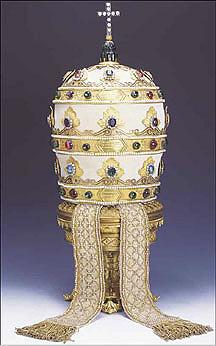
I've been enjoying the beaches and warm Gulf waters here on South Padre Island since the weekend, and plan to finish out my vacation in relative intellectual inactivity. But naturally my thoughts do turn from time to time to theology, and specifically to the discussion of papal primacy that began before my vacation. I'd like to share a few observations with you now.
First, the formal dogmatic definitions relating to the extent and nature of the universal primacy of the Papacy were made since 1054, that is to say, not only within the context of a divided church but one in which the Western delimitations of the one, holy, catholic and apostolic Church were virtually reckoned as coterminus with the jurisdictional bounds of the Western Patriarchate, i.e., the Latin Church (setting aside for the moment the question of the Eastern Catholic, a.k.a. Uniate churches).
This is not to say that Rome did not make such claims before the Great Schism, but that the particular dogmas that have presented such seemingly insurmountable obstacles to reunion with the East (e.g., Vatican 1) were defined subsequent to the East/West divide. The importance of this observation I trust will become apparent in light of my second observation.
Second, such controversial definitions as Pastor Aeternus are historically and jurisdictionally conditioned. The waning temporal power of the Papacy in the 19th century combined with the Church's struggle against modernity in both the political and theological realms are apparent to any astute reader of the history leading up to the First Vatican Council. However, the jurisdictional conditions are not readily appreciated, and I think this is where more work on the ecumenical front needs to be done. (This is no doubt due primarily to the Roman Catholic claim of ecclesiastical ultimacy -- i.e., that the Roman Communion, in and of itself and all by itself, is the Catholic Church in its fullness.)
Among the many titles that have been ascribed to the Pope in history, three stand out for attention: (1) Bishop of Rome, (2) Patriarch of the West, and (3) Universal Pastor. In the papacy's own self-consciousness all other titles, rights, and authority stem from the first of these, i.e. "Bishop of Rome." The Roman Church's apostolic pedigree afforded it a prestige that was unrivaled by any other church, and its special role as the guardian of the apostolic faith was unquestioned among the ancients. With regards to the third title -- Universal Pastor -- I would contend that this was originally exercised (i.e., during the first millennium) as a primus inter pares role amongst the five great Patriarchates (Rome, Constantinople, Alexandria, Antioch, and Jerusalem) -- much like the ecumenical patriarchal role that Constantinople enjoys today in the East.
It is in the capacity of the second role -- Patriarch of the West -- that Rome has over time, and especially in the post-schism era, extended its jurisdictional authority more or less successfully. This is where I believe the jurisdictional conditioning of Rome's dogma of papal supremacy, particularly Pastor Aeternus, is relevant. Since 1054 the Western Patriarchate has become not only worldwide in its scope but virtually universal in its self-perception. I suggest that what has happened in the wake of the Great Schism is the blurring and confusion of the roles of "Patriarch of the West" and "Universal Pastor," and that Rome's present stance on primacy, which ascribes a universal, immediate and ordinary jurisdiction to the Pope, should be read as applying only to the Western Patriarchate and her subsidiary Eastern satellites (i.e., the Eastern Catholics), and NOT to the other four Patriachates (in which case a primacy of honor, rather than jurisdiction, would be not only more acceptable but more in line with the Pope's role in the first millennium).
Anyway, these thoughts are still seminal. I appreciate any suggestions or comments.
Until next time.
Friday, June 02, 2006
On Vacation: South Padre Island

Well, folks, all the time I thought I was going to have to blog this week turned out to be wishful thinking. Look for something over the weekend at the earliest. I should be back in full swing by the middle of next week.
In the meantime, the beach on South Padre Island, Texas is beautiful and the water of the Gulf of Mexico is blue and warm.
Until next time.
Subscribe to:
Posts (Atom)


